
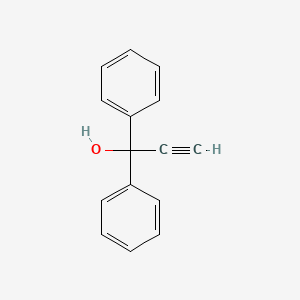
CAS · 3923-52-2
Product Overview
Diphenylethynylcarbinol is a high-purity pharmaceutical-intermediates supplied for industrial and specialty chemical applications. Contact our team for specifications, packaging options and lead times.
Product Specifications
| Appearance: | White solid |
|---|---|
| Purity (HPLC): | 98% min |
| Assay: | Report (98.18% for this batch) |
| NMR: | C-NMR, H-NMR, consistent with the structure |
| MS: | MS consistent with the molecular weight |
| Single impurity: | 1.0% max |
Applications
1. Pharmaceutical and Medicinal Chemistry
Acts as an intermediate in the synthesis of complex pharmaceutical agents.
The compound's alkyne functionality makes it suitable for click chemistry and Sonogashira-type cross-coupling reactions, leading to drug-like molecules.
Serves in the development of antitumor, anti-inflammatory, and enzyme-modulating agents in research contexts.
2. Material Science and Polymer Chemistry
Used as a monomer or comonomer in specialty polymer synthesis, especially in liquid crystal materials, optical polymers, or photoresists.
The rigid and planar geometry of the diphenyl and ethynyl structure provides thermal stability and optical clarity to the resulting materials.
3. Organic Synthesis Building Block
Useful for introducing propargylic alcohol functionalities into larger molecules.
Can participate in reactions such as:
Esterifications
Alkylations
Oxidations to yield α,β-unsaturated ketones or other functionalized products.
Reacts well in metal-catalyzed couplings and nucleophilic substitutions, expanding its utility in synthetic routes.
4. Research in Photophysics and Electronics
The extended π-system provided by the phenyl groups and alkyne makes it of interest in:
Fluorescent dye development
Charge-transport materials
OLEDs (organic light-emitting diodes)
Benefits
Versatile functionality: Offers a triple bond, hydroxyl group, and aromatic rings for diverse chemical transformations.
Electron-rich structure: Useful for electronic and optical materials.
Stable under ambient conditions: Facilitates ease of handling in research labs.
Conclusion
A concise summary and suitability assessment for this product is available on request. Contact our team to discuss whether it fits your process and quality requirements.