
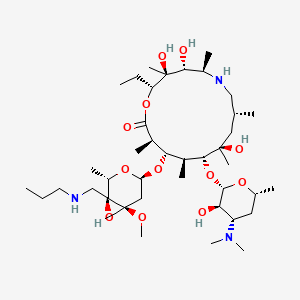
CAS · 217500-96-4
Product Overview
Tulathromycin A is a high-purity veterinary-medicine supplied for industrial and specialty chemical applications. Contact our team for specifications, packaging options and lead times.
Product Specifications
| Appearance: | White or almost white crystalline powder |
|---|---|
| Assay of Tulathromycin A (on the dried substance): | 96.0%~102.0% |
| Solubility: | Freely soluble in methanol, acetone, ethyl acetate; Soluble in ethanol |
| Identification: | |
| HPLC: | The retention time of the major peak corresponds to that of the reference substance solution, as obtained in the Assay. |
| IR spectrum: | IR spectrum of sample corresponds to that of reference |
| Water Content: | 0.5% max. |
| Residual Solvents: | |
| Methylene chloride: | 600 ppm max. |
| Heptane: | 5000 ppm max. |
| Ethyl acetate: | 5000 ppm max. |
| Specific Rotation: | -22° ~ -26° |
| Residue on Ignition: | 0.20% max. |
| Heavy Metals: | 20 ppm max. |
| Related Substances: | |
| Impurity D: | 0.50% max. |
| Tulathromycin B: | 1.0% max. |
| Impurity C: | 0.50% max. |
| Impurity E: | 0.50% max. |
| Impurity F: | 0.50% max. |
| Any single impurity: | 0.20% max. |
| Total impurities: | 3.0% max. |
Applications
1. Veterinary Medicine (Antibiotic)
Tulathromycin A is a broad-spectrum macrolide antibiotic used primarily in livestock. It is approved for the treatment and prevention of various bacterial respiratory diseases in:
Cattle (Bovine Respiratory Disease, or BRD)
Swine (Swine Respiratory Disease, or SRD)
Sheep and Goats (off-label or under specific country regulations)
2. Treatment of Specific Bacterial Infections
It is effective against major pathogens such as:
Mannheimia haemolytica
Pasteurella multocida
Histophilus somni
Actinobacillus pleuropneumoniae
Mycoplasma bovis and Mycoplasma hyopneumoniae
These are the leading causes of respiratory illnesses in livestock, particularly under conditions of stress (e.g., transport, weaning).
3. Metaphylaxis
Used preventively in groups of animals at high risk of disease, helping reduce morbidity and mortality in herds or flocks, especially after transportation or exposure to pathogens.
Benefits
1. Long-Acting Activity
One of the key advantages of Tulathromycin A is its long plasma half-life, enabling single-dose therapy.
Provides sustained antibiotic levels in lung tissue for up to 9–15 days, reducing the need for repeated injections.
2. Broad-Spectrum Efficacy
Effective against both Gram-negative and Gram-positive respiratory pathogens, and atypical organisms like Mycoplasma spp.
3. Good Tissue Penetration
Demonstrates excellent penetration into lung tissues, which is essential for respiratory disease treatment.
Maintains therapeutic concentrations even in hard-to-reach areas.
4. Improved Animal Welfare and Productivity
Reduces disease outbreaks and supports weight gain, feed efficiency, and overall herd health.
Fewer injections mean less stress on animals and lower labor costs for producers.
5. Safety and Tolerance
Tulathromycin A has shown good safety profiles in cattle and swine, with minimal adverse effects when administered at recommended doses.
Conclusion
Tulathromycin A (CAS 217500-96-4) is a next-generation macrolide antibiotic widely used in modern veterinary medicine to treat and prevent respiratory infections in livestock. Its long-acting nature, broad-spectrum efficacy, and single-dose convenience make it a valuable tool for maintaining animal health, reducing antibiotic usage, and improving livestock productivity. With its targeted activity and favorable safety profile, Tulathromycin A continues to play a critical role in sustainable livestock management.
Previous
Oxytetracycline Hydrochloride丨CAS 2058-46-0
Next