
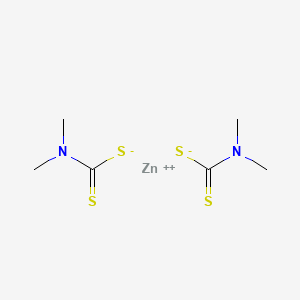
CAS · 137-30-4
Product Overview
Zinc bis dimethyldithiocarbamate is a high-purity bactericides supplied for industrial and specialty chemical applications. Contact our team for specifications, packaging options and lead times.
Product Specifications
| Appearance | White or slightly yellow powder |
|---|---|
| Melting point | 244℃ min |
| Zn | 20.5 - 22% |
| Heating loss | 0.5% max |
| Sieve residue (100 items) | 0.1% max |
Applications
Zinc bis(dimethyldithiocarbamate) (CAS 137-30-4) is a versatile organometallic compound primarily used as a fungicide, preservative, and accelerator in industrial applications. Its main application in agriculture is as a broad-spectrum fungicide for controlling fungal diseases in crops such as cereals, fruits, vegetables, and ornamental plants. It is effective against seed-borne, soil-borne, and foliar pathogens, protecting plants from damping-off, leaf spots, blights, and molds. The compound is commonly applied as a seed treatment or foliar spray, where it forms a protective barrier that prevents fungal growth and infection. Beyond agriculture, Zinc bis(dimethyldithiocarbamate) is also utilized in the rubber and polymer industries as an accelerator in vulcanization, and in paints and coatings to prevent microbial degradation, extending the durability and performance of materials.
Benefits
The benefits of Zinc bis(dimethyldithiocarbamate) are multifaceted, stemming from its fungicidal potency and versatility. In agriculture, it enhances seed germination and plant vigor by preventing early-stage fungal infections, contributing to higher yields and better-quality produce. Its broad-spectrum activity reduces the need for multiple fungicides, offering cost efficiency and simplified crop protection strategies. In industrial applications, its use as a vulcanization accelerator improves the mechanical properties and longevity of rubber products, while its antimicrobial properties in coatings and paints help prevent spoilage and structural damage. Additionally, its dual functionality in both agriculture and industry makes it a highly valuable compound for diverse applications where protection against fungal or microbial degradation is critical.
Conclusion
In conclusion, Zinc bis(dimethyldithiocarbamate) is an important compound with wide-ranging applications in crop protection and industrial processes. Its effectiveness as a fungicide, coupled with its industrial uses as a preservative and accelerator, makes it a highly versatile and beneficial chemical. By supporting plant health, enhancing crop yields, and improving the durability of industrial materials, it provides significant economic and practical advantages across multiple sectors when applied responsibly and according to safety guidelines.
Previous
1,2-Benzenediamine丨CAS 95-54-5
Next