
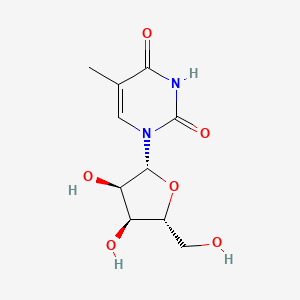
CAS · 1463-10-1
Product Overview
Ribosylthymine is a high-purity nucleosides-nucleotides supplied for industrial and specialty chemical applications. Contact our team for specifications, packaging options and lead times.
Product Specifications
| Appearance | White or almost white crystalline powder |
|---|---|
| Loss on drying | 0.5% max |
| Residue on ignition | 0.3% max |
| Purity (HPLC) | 99% min |
Applications
1. Biochemical and Molecular Biology Research
Ribosylthymine丨CAS 1463-10-1 serves as a model compound for studying nucleoside structure, metabolism, and interaction with enzymes involved in nucleic acid metabolism, particularly in RNA-related processes.
● RNA Analog Studies: Unlike thymidine (which is found in DNA), ribosylthymine is a rare or non-natural RNA nucleoside. It is used to explore non-canonical base incorporation in synthetic RNA or engineered nucleic acids.
● Ribonucleoside Transport and Metabolism Studies: Useful in studying the transport mechanisms of ribonucleosides across membranes and their catabolism by nucleosidases and nucleoside phosphorylases.
2. Pharmaceutical and Drug Discovery
● Serves as a precursor or scaffold for the synthesis of modified nucleoside analogues, which are often evaluated for antiviral, anticancer, or antibacterial properties.
● Modified ribosylthymine derivatives are studied for enzyme inhibition, particularly those involved in nucleotide biosynthesis.
3. Precursor in Nucleotide Synthesis
● Acts as an intermediate or starting material for synthesizing nucleotides and nucleoside analogs through phosphorylation reactions or glycosylation of thymine.
● Also used to prepare radiolabeled or fluorescent nucleotides for probing biochemical reactions.
4. RNA Structure and Function Studies
● When incorporated into synthetic RNA, it allows researchers to investigate the effects of base modifications on RNA folding, hybridization, and function.
● Occasionally used in riboswitch or ribozyme engineering to test how base substitutions alter regulatory function.
Benefits
✅ Chemical Versatility
● The ribose moiety makes it more reactive than deoxynucleosides, enabling modification at the 2' and 3' hydroxyl positions for a wide range of synthetic chemistry applications.
✅ Model Compound
● Provides a simplified yet relevant analogue of natural nucleosides, making it an ideal substrate for biochemical assays and enzyme kinetics.
✅ Foundation for Drug Design
● Derivatives of ribosylthymine have shown potential in nucleoside-based drug discovery, especially in inhibitors of DNA/RNA processing enzymes.
✅ Useful in Radiolabeling
● Can be easily labeled with isotopes (e.g., tritium or carbon-14) for use in tracking nucleoside uptake and metabolism in biological systems.
✅ RNA Mimicry in Research
● Enables exploration of RNA structure and base recognition, especially when studying differences between uridine- and thymine-containing RNA analogs.
Conclusion
Ribosylthymine丨CAS 1463-10-1 plays a specialized but important role in biochemical, nucleic acid, and pharmaceutical research. Although not a standard nucleoside in natural RNA, it serves as a valuable analog for studying nucleoside function, enzyme interactions, and molecular modifications. Its structure allows for synthetic flexibility and biochemical relevance, making it a critical tool in nucleoside chemistry and drug development.
Previous
2'-Deoxyguanosine Monohydrate丨CAS 312693-72-4
Next
1,3,4,6-Tetra-O-acetyl-N-azidoacetylmannosamine丨CAS 361154-30-5