CAS · 474688-73-8
Product Overview
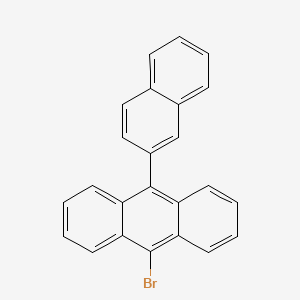
9-Bromo-10-(2-naphthyl)anthracene is a high-purity oled-materials supplied for industrial and specialty chemical applications. Contact our team for specifications, packaging options and lead times.
Product Specifications
| Appearance: | Yellow to light yellow powder |
|---|---|
| Purity (HPLC): | 99.9% min |
| MP: | 166.0~170.0 deg.C |
Applications
1. OLED Materials
Frequently used in the synthesis of blue-light emitting materials in OLED (Organic Light-Emitting Diode) devices.
The anthracene core is well-known for high fluorescence quantum yield and excellent charge transport.
2. Suzuki & Stille Coupling Reactions
The bromine substituent at the 9-position makes it suitable for palladium-catalyzed cross-coupling reactions.
Enables the formation of extended π-conjugated systems used in organic semiconductors.
3. Organic Photonics
A key building block in the development of photonic materials for applications such as:
Organic lasers
Light-emitting transistors
4. Research in Organic Synthesis
Valuable intermediate for constructing polycyclic aromatic hydrocarbons (PAHs) with tailored optoelectronic properties.
Benefits
Versatile Reactivity: The aryl bromide group allows for diverse functionalizations via cross-coupling.
High Photostability: Anthracene-based systems offer excellent thermal and light stability.
Efficient Blue Emission: Useful for developing high-efficiency deep-blue emitters, essential in full-color OLED displays.
Enhanced π-Conjugation: The naphthyl group extends the conjugation, improving electron mobility and optical characteristics.
Conclusion
9-Bromo-10-(2-naphthyl)anthracene (CAS 474688-73-8) is a crucial compound in OLED and organic electronic materials development. Its unique combination of a reactive bromine, a conjugated anthracene core, and a naphthyl group enables it to serve as a precursor for high-performance optoelectronic materials, particularly for blue-emitting devices. It is highly valued in both academic and industrial R&D targeting next-generation displays and organic semiconductors.
Previous
4-Chloro-4-cyanobiphenyl丨CAS 57774-36-4
Next
9-(1,1-biphenyl-3-yl)-3-(4,4,5,5-tetramethyl-1,3,2-dioxaborolan-2-yl)-9H-carbazole丨CAS 1533406-38-0