
2-Cyclopropyl-4-(4-fluorophenyl)-3-quinolinylmethyltriphenylphosphonium bromide
CAS 154057-58-6
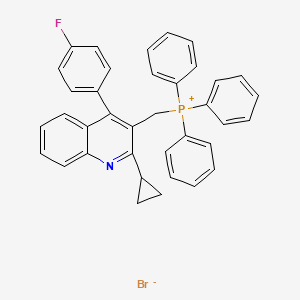
CAS · 154057-58-6
Product Overview
2-Cyclopropyl-4-(4-fluorophenyl)-3-quinolinylmethyltriphenylphosphonium bromide is a high-purity pharmaceutical-intermediates supplied for industrial and specialty chemical applications. Contact our team for specifications, packaging options and lead times.
Product Specifications
| Appearance: | White to off-white powder |
|---|---|
| Assay: | 99% min |
| Identification: | HPLC: In the assay test, the retention time of sample must match with retention time of standard |
| Loss on drying: | 0.5% max |
| Residue on ignition: | 1.0% max |
| Residual solvents (THF): | 0.072% max |
| Related substances: | Triphenylphosphine: 0.2% max Des-fluoro impurity: 0.1% max Other maximum impurity: 0.3% max Total impurities: 1.0% max |
Applications
This compound is primarily used in pharmaceutical and biochemical research, where the triphenylphosphonium cation serves as a mitochondria-targeting group due to its ability to accumulate across mitochondrial membranes driven by membrane potential. It acts as a key intermediate or conjugation partner in the synthesis of mitochondria-directed drugs, fluorescent probes, and redox-active molecules. The quinoline scaffold contributes additional biological relevance, as it is a common motif in antimalarial, anticancer, and antimicrobial agents. In chemical biology, the compound is used to develop mitochondrial imaging agents and delivery systems for bioactive molecules. Additionally, in organic synthesis and materials science, it functions as a precursor for phosphonium salts and ionic materials with potential use in phase-transfer catalysis and photoactive systems.
Benefits
The benefits of 2-Cyclopropyl-4-(4-fluorophenyl)-3-quinolinylmethyltriphenylphosphonium bromide arise from its multifunctional structure, stability, and targeted delivery capability. The phosphonium moiety facilitates selective mitochondrial localization, enhancing the efficiency of mitochondrial drug delivery or imaging. The quinoline and fluorophenyl components provide rigidity, lipophilicity, and potential biological activity, while the cyclopropyl group adds steric and electronic diversity useful for fine-tuning molecular interactions. The compound exhibits good solubility in organic solvents, excellent thermal stability, and compatibility with a variety of conjugation chemistries, making it suitable for use in both laboratory research and advanced formulation studies.
Conclusion
In summary, 2-Cyclopropyl-4-(4-fluorophenyl)-3-quinolinylmethyltriphenylphosphonium bromide is a multifunctional organophosphorus compound widely used in biomedical, synthetic, and materials research. Its combination of a biologically active quinoline core and a mitochondria-targeting phosphonium group makes it a valuable tool for developing targeted therapeutics, fluorescent markers, and functional organic materials. With its chemical versatility, stability, and structural sophistication, it continues to play a significant role in advancing mitochondrial biology and precision drug design.
Previous
Tert-Butyl Trans-3-amino-4-(difluoromethyl)pyrrolidine-1-carboxylate丨CAS 1428776-48-0
Next