
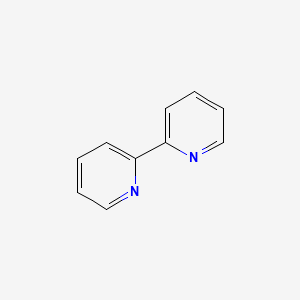
CAS · 366-18-7
Product Overview
2,2-Dipyridyl丨CAS 366-18-7 is a heterocyclic compound that consists of two pyridine rings connected by a carbon-carbon single bond. The chemical structure of 2,2-dipyridyl makes it a versatile ligand and has wide applications in various fields such as coordination chemistry, materials science, and chemical synthesis. Its ability to bind metal ions and form complex structures is highly utilized in both research and industrial applications.
Product Specifications
| Property | Specification |
|---|---|
| Appearance | White to off-white crystal powder |
| Assay | 99% min |
| 2-CYANOPYRIDINE | 0.1% max |
| Methanol | 0.3% max |
| Other single impurity/EACH | 0.1% max |
Applications
1. Coordination Chemistry and Metal Complexation
● 2,2-Dipyridyl丨CAS 366-18-7 acts as a bidentate ligand in coordination chemistry. It readily forms stable complexes with transition metals such as iron (Fe), copper (Cu), nickel (Ni), and cobalt (Co).
● Metal-ligand complexes formed with 2,2-dipyridyl are often used in:
Catalysis: Particularly in organometallic catalysis and synthesis of metal-based catalysts.
Sensing: For the detection of metal ions or other analytes.
Electrochemical studies: In the development of biosensors and chemical sensors.
2. Chemical Synthesis and Organometallic Chemistry
● 2,2-Dipyridyl is widely used in the synthesis of organometallic compounds. The ligand can facilitate the formation of organometallic intermediates that are crucial in organic reactions.
● The chelating ability of 2,2-dipyridyl makes it valuable for synthesizing complex molecules with specific functionalities.
3. Analytical Chemistry
● 2,2-Dipyridyl is employed in spectroscopic methods, especially in combination with transition metals, to study the electronic properties of the complexes.
● It is also utilized in UV-visible absorption spectroscopy, where metal-complexed 2,2-dipyridyls show characteristic absorption peaks, allowing for their detection in solution.
4. Polymer and Materials Science
● 2,2-Dipyridyl丨CAS 366-18-7 can be incorporated into polymeric materials for the development of metal-binding polymers. These materials are used in areas such as:
Environmental cleanup: Removing metal ions from contaminated water.
Catalysis: Development of polymeric catalysts for industrial chemical processes.
5. Biochemistry and Medicinal Chemistry
● While 2,2-dipyridyl itself is not typically used directly in drug formulations, its coordination ability with metal ions makes it an important tool in the study of metal-dependent enzymes and biochemical processes.
● It can also serve as a metal ion chelator in biological research, which can be useful in studying metal ion interactions within the body or as part of the treatment of metal toxicity.
6. Agriculture
● The metal-binding properties of 2,2-dipyridyl have been explored for applications in agriculture, specifically in the development of chemical formulations to help plants absorb necessary nutrients or protect them from toxic metals in soil.
Benefits
1. Ligand Flexibility and Stability
● 2,2-Dipyridyl丨CAS 366-18-7 is a bidentate ligand, meaning it can coordinate to metals at two sites, leading to the formation of stable metal-ligand complexes.
● This dual coordination offers greater stability and selectivity for metal complexation compared to monodentate ligands.
2. Catalytic Applications
● Due to its ability to form stable metal complexes, 2,2-dipyridyl is widely used in the development of metal catalysts for various organic transformations.
● Metal complexes of 2,2-dipyridyl are often utilized in hydrogenation, oxidation, and cross-coupling reactions, making it an important tool in green chemistry.
3. Versatile in Organic Synthesis
● The metal complexes formed by 2,2-dipyridyl can be used as intermediates in organic synthesis, offering selectivity in the formation of C-C and C-H bonds.
● The compounds can facilitate synthetic pathways that would otherwise be difficult or inefficient.
4. Electrochemical Properties
● Metal-complexed 2,2-dipyridyl compounds exhibit interesting electrochemical properties that are important for the development of battery technologies, fuel cells, and sensors.
5. Environmental Applications
● The ability of 2,2-dipyridyl to form complexes with metals makes it useful in environmental chemistry, particularly in processes related to water treatment and the removal of heavy metal ions from contaminated water bodies.
● It helps in decontamination efforts by binding and isolating toxic metals from the environment.
Conclusion
2,2-Dipyridyl丨CAS 366-18-7 is a versatile and valuable compound in coordination chemistry, organometallic synthesis, and electrochemical applications. Its ability to form stable metal complexes makes it an indispensable tool in a wide variety of scientific fields, including catalysis, analytical chemistry, biochemistry, and materials science. Whether for metal ion sensing, catalysis, or the development of functionalized polymers, 2,2-dipyridyl offers significant advantages in both research and industrial applications.
Would you like to know more about specific metal complexes formed with 2,2-dipyridyl or its applications in nanomaterials?
Previous
2-Bromobenzaldehyde丨CAS 6630-33-7
Next