
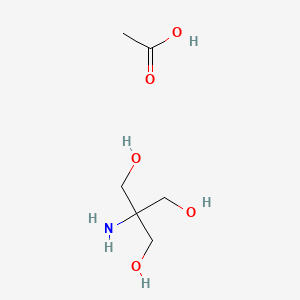
CAS · 6850-28-8
Product Overview
Trizma acetate is a high-purity biological-buffer supplied for industrial and specialty chemical applications. Contact our team for specifications, packaging options and lead times.
Product Specifications
| Appearance | White crystalline powder |
|---|---|
| Assay | 99.5% min |
| Solubility (40% water) | Clear, colorless solubility |
| Melting Point (Mp) | 168.0℃ to 171.0℃ |
| Water Content | 0.2% max |
| pH (5% water) | 10.0 to 11.5 |
| Heavy metals | 5 ppm max |
| Iron ion | 0.0001% max |
| Sulfate | 0.001% max |
| Chloride | 0.0003% max |
| Ultraviolet absorbance (280nm, 40% water) | 0.07 max |
| Ultraviolet absorbance (400nm, 40% water) | 0.02 max |
Applications
1. Biological Buffer System
Trizma acetate is widely used in molecular biology, biochemistry, and cell biology as a buffer with enhanced buffering at near-neutral pH.
It combines Tris base with acetic acid, forming a buffer with improved buffering capacity in slightly acidic to neutral pH environments.
2. Electrophoresis and Gel Systems
Employed in agarose and polyacrylamide gel electrophoresis for DNA, RNA, and proteins, particularly where low conductivity and minimal heat generation are desired.
3. Protein and Nucleic Acid Work
Used in enzymatic reactions, antibody conjugation, and DNA/RNA purification protocols where a stable, low-interference buffer is essential.
4. Cell and Tissue Culture
Suitable for buffering biological fluids and culture media, especially in systems where carbon dioxide buffering is not practical.
5. Pharmaceutical and Diagnostic Formulations
Included in in vitro diagnostic reagents and formulated biologicals requiring precise pH control near neutrality.
Benefits
✅ pH Stability
Maintains stable pH in the physiological range, ideal for most biological reactions and cell systems.
✅ Low Ionic Strength
Trizma acetate exhibits low ionic strength, reducing electrical conductivity in electrophoresis, minimizing sample overheating and improving resolution.
✅ Compatible with Metal Ions
Low metal ion chelation makes it compatible with metal-dependent enzymes and reactions.
✅ High Solubility and Stability
Freely soluble in water and stable under standard lab conditions, making it convenient and reliable for routine use.
✅ Biologically Inert
Non-toxic and non-interfering with enzymatic or cellular processes, making it well-suited for sensitive assays and cell work.
Conclusion
TAPS (CAS 29915-38-6) is a reliable and biocompatible alkaline buffer widely used in biochemistry, molecular biology, electrophoresis, and pharmaceutical applications. Its excellent stability, minimal interference with biomolecules, and effective buffering range make it an essential tool for scientists requiring precise pH control in neutral to slightly alkaline environments.
Previous
N-[Tris(hydroxymethyl)methyl]acrylamide丨CAS 13880-05-2
Next