
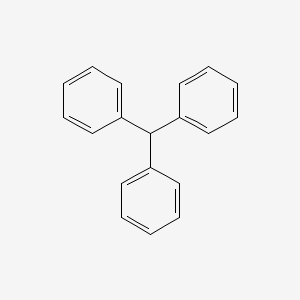
CAS · 519-73-3
Product Overview
Triphenylmethane is a high-purity catalysts-auxiliary-agent supplied for industrial and specialty chemical applications. Contact our team for specifications, packaging options and lead times.
Product Specifications
| Appearance | Off-white to white crystalline powder |
|---|---|
| Assay | 99% min |
| M.P | 92-94 °C |
| Water | 0.5% max |
Applications
Triphenylmethane (CAS 519-73-3) is an aromatic hydrocarbon that serves as a foundational compound in organic synthesis, particularly for the preparation of triphenylmethyl (trityl) derivatives and dyes. It is the parent structure for the triphenylmethane dye family, including crystal violet, malachite green, and fuchsine, which are widely used in textiles, inks, and biological staining. In organic chemistry, triphenylmethane functions as a precursor for protecting groups (trityl groups) applied to alcohols and amines, offering stability and easy removal under mild conditions. It is also utilized in research as a model compound for studying carbocation stability and aromatic conjugation effects. In materials science, triphenylmethane derivatives find use in optoelectronic materials, photonic devices, and advanced polymer formulations.
Benefits
The primary benefits of triphenylmethane lie in its stable aromatic framework and its ability to form resonance-stabilized carbocations, making it an excellent core for dye and protective group chemistry. Its strong conjugation enhances color intensity and light absorption, which is essential for dye and pigment production. The trityl derivatives derived from triphenylmethane offer practical advantages in synthesis due to their selective reactivity and reversible protection characteristics. Moreover, triphenylmethane is chemically stable, readily available, and compatible with various organic solvents and reagents, allowing wide adaptability across both research and industrial settings.
Conclusion
Triphenylmethane is a versatile and fundamental compound with critical roles in dye manufacturing, synthetic chemistry, and materials research. Its stable aromatic structure and ability to form reactive intermediates make it invaluable in the preparation of trityl-protected compounds and vibrant dyes. With applications spanning from traditional coloration to modern materials science, triphenylmethane continues to serve as a cornerstone molecule in both academic and industrial chemistry.
Previous
Tris(triphenylphosphine)ruthenium(II) Chloride丨CAS 15529-49-4
Next