CAS · 134652-60-1
Product Overview
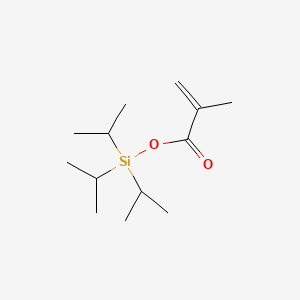
triisopropylsilyl Methacrylate is a high-purity silicon-compounds supplied for industrial and specialty chemical applications. Contact our team for specifications, packaging options and lead times.
Product Specifications
| Appearance: | Colorless liquid |
|---|---|
| Purity: | 99% min |
Applications
Triisopropylsilyl Methacrylate is a specialized monomer used in polymer and material synthesis. Its defining feature is the triisopropylsilyl (TIPS) group-a bulky, hydrophobic protecting moiety that modifies both chemical reactivity and physical properties. It finds use in several advanced fields:
1. Functional Monomer in Polymer Synthesis
TIPS-MA is primarily used as a functional monomer in radical polymerization to prepare:
Block copolymers
Hydrophobic acrylic resins
Crosslinkable materials
Because of its large silyl group, it introduces steric hindrance and hydrophobicity, allowing control over polymer microstructure and surface properties.
2. Surface Modification and Coatings
TIPS-MA imparts hydrophobic, non-stick, and anti-fouling characteristics when incorporated into polymers for surface coatings:
Used in protective films, optical coatings, release liners, and anti-scratch surfaces
Enhances water repellency, weather resistance, and chemical durability
It is especially valued in modifying surfaces where reduced adhesion or interaction with water or contaminants is desired.
3. Photoresist and Lithography
In semiconductor manufacturing, TIPS-MA derivatives are used in photoresist materials due to:
Their resistance to etching
Their tunable glass transition temperatures (Tg)
Their low surface energy properties
It contributes to improved resolution and pattern fidelity in microfabrication, particularly in dry etching processes.
4. Nanostructured Materials
TIPS-MA is used in preparing nanoporous films and polymer brushes via:
Block copolymer self-assembly
Controlled radical polymerization (e.g., ATRP, RAFT)
These materials are valuable in membranes, separation processes, biosensors, and responsive materials, where selective transport or chemical resistance is essential.
5. Biomedical and Drug Delivery Systems
Though less common, TIPS-MA can be used in tailored hydrophobic domains of biocompatible polymers to:
Tune degradation rates
Control surface properties for bio-inert or bioactive coatings
Reduce protein adsorption or cell adhesion
Its steric hindrance can also aid in enzyme resistance or controlled deprotection strategies.
Benefits
The chemical and physical benefits of Triisopropylsilyl Methacrylate make it a versatile component in high-performance polymer systems:
1. Hydrophobicity
The triisopropylsilyl group introduces significant hydrophobicity, making the resulting polymers water-repellent and suitable for anti-fouling coatings.
Improves chemical resistance and weather durability in exposed environments.
2. Steric Protection and Surface Control
The bulky silyl moiety reduces reactivity at adjacent sites, allowing selective reactions or protection during multi-step synthesis.
In surface engineering, it controls interfacial energy and wetting behavior, useful in microfluidics, sensor interfaces, and biomedical devices.
3. Controlled Polymerization
Compatible with controlled/living radical polymerization techniques (e.g., RAFT, ATRP), enabling:
Precise molecular weight control
Block copolymer synthesis
Post-polymerization functionalization
4. Deprotection Versatility
Under fluoride ion treatment (e.g., with TBAF), the TIPS group can be selectively removed.
This allows post-synthetic modification of polymer surfaces or the introduction of reactive groups at desired stages.
5. Thermal and UV Stability
TIPS-MA contributes to thermally stable and UV-resistant polymers, especially important in coatings and electronics.
The methacrylate backbone offers a robust platform, while the TIPS side chain adds protective performance.
6. Tunable Properties in Copolymers
When copolymerized with hydrophilic or reactive monomers (e.g., PEGMA, acrylates), TIPS-MA balances hydrophobic/hydrophilic behavior, mechanical flexibility, and responsiveness.
Enables the design of smart surfaces, stimuli-responsive films, and asymmetric membranes.
Conclusion
Triisopropylsilyl Methacrylate (CAS 134652-60-1) is a specialty monomer offering both functional versatility and performance enhancement in polymer chemistry. With its bulky, hydrophobic TIPS group, it imparts unique characteristics such as:
Improved surface hydrophobicity
Steric protection and selective reactivity
Excellent thermal and chemical resistance
Compatibility with advanced polymerization techniques
This makes it a valuable ingredient in high-end coatings, microfabrication, membrane science, photoresist technology, and specialty copolymers. Its role in modifying material interfaces, resisting fouling, and facilitating post-functionalization continues to drive innovation in both industrial and research-scale applications.
Previous
Potassium Trimethylsilanolate丨CAS 10519-96-7
Next