
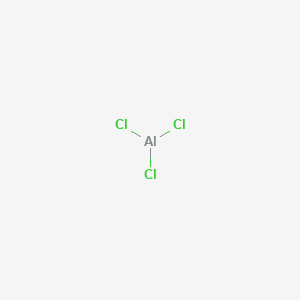
CAS · 7446-70-0
Product Overview
Aluminium chloride丨CAS 7446-70-0 is a highly versatile Lewis acid and industrial chemical with wide-ranging applications across chemical synthesis, petrochemicals, pharmaceuticals, cosmetics, and water treatment. Its catalytic and reactive properties make it one of the most important reagents in both organic and inorganic chemistry.
Product Specifications
| Grade | Electronic level |
|---|---|
| Appearance | White Powder or Chunks |
| Purity (Based on Trace Metals Impurities by ICP) | 99.999% min |
| X-Ray Diffraction | Conforms to Structure |
| Total Metallic Impurities | 10 ppm max |
| Water (Karl Fischer) | 1.05% max |
Applications
1. Catalyst in Organic Synthesis
A. Friedel–Crafts Reactions
● One of the primary uses of aluminium chloride is as a Lewis acid catalyst in Friedel–Crafts alkylation and acylation.
● Used to attach alkyl or acyl groups to aromatic rings, a crucial step in manufacturing dyes, fragrances, pharmaceuticals, and agrochemicals.
B. Polymerization and Isomerization
● Catalyzes the polymerization of olefins and isomerization of hydrocarbons, useful in petrochemical processing.
● Applied in producing synthetic rubbers and lubricants.
2. Petrochemical Industry
● Used in the cracking and reforming of hydrocarbons to produce gasoline, diesel, and lubricating oils.
● Facilitates the conversion of aromatics and alkanes into high-value fuel and chemical intermediates.
3. Pharmaceuticals
● Acts as a reagent or catalyst in the synthesis of active pharmaceutical ingredients (APIs).
● Helps in forming heterocycles and aromatic intermediates, especially for anti-inflammatory, anticancer, and antimicrobial drugs.
4. Fragrance and Flavor Industry
● Key catalyst in synthesizing aromatic ketones and aldehydes, often found in perfumes and flavors.
● Enhances yield and purity in the production of fine chemicals.
5. Cosmetics and Personal Care
● Hydrated AlCl₃ (especially aluminium chlorohydrate) is used as an active ingredient in antiperspirants.
● Works by temporarily plugging sweat ducts and reducing perspiration.
6. Water Treatment
● Used in coagulation and flocculation to remove suspended particles from water.
● Effective in treating industrial wastewater and municipal drinking water systems.
7. Metal Processing
● In aluminium metallurgy, it is sometimes used in the production and purification of aluminium metal.
● Acts as a flux or refining agent in electrolytic processes.
Benefits
1. Highly Effective Catalyst
● Strong Lewis acid properties enable AlCl₃ to activate a wide range of substrates.
● Facilitates complex organic transformations under relatively mild conditions.
2. Versatile Industrial Reagent
● Useful in both homogeneous and heterogeneous reactions.
● Applicable across a diverse range of industries including fine chemicals, petrochemicals, and pharmaceuticals.
3. Improved Reaction Efficiency
● Enhances yields and selectivity in key chemical reactions.
● Often reduces the need for harsh conditions such as high temperature or pressure.
4. Cost-Effective
● Readily available and economical for large-scale industrial processes.
● Common choice over more expensive catalysts or reagents.
5. Functional in Both Organic and Aqueous Systems
● Anhydrous AlCl₃ is ideal for non-aqueous synthesis, while hydrated AlCl₃ is suitable for aqueous applications, such as water treatment and cosmetics.
Conclusion
Aluminium chloride丨CAS 7446-70-0 is a powerful Lewis acid and indispensable reagent across multiple scientific and industrial domains. From catalyzing key organic reactions to improving water quality and controlling perspiration, AlCl₃'s versatility, efficiency, and relative affordability make it a staple in laboratories and factories alike. However, careful handling and environmental responsibility are essential due to its reactivity and corrosive nature.
Previous
Potassium Hexafluorophosphate丨CAS 17084-13-8
Next