
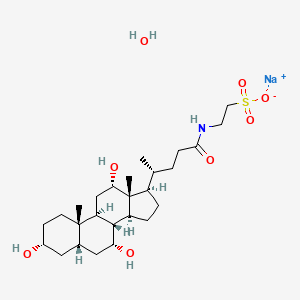
CAS · 345909-26-4
Product Overview
Sodium taurocholate hydrate丨345909-26-4 is a bile salt and a surfactant commonly used in biological and biochemical applications. It is the sodium salt of taurocholic acid, a bile acid that plays a key role in the emulsification and digestion of fats in the gastrointestinal system. It is typically encountered as a hydrate, meaning it is present with water molecules in its crystalline form.
Product Specifications
| Property | Specification |
|---|---|
| Appearance | White or almost white powder |
| Sodium cholate (TLC) | 0.5% max |
| Sodium taurodeoxycholate (TLC) | 0.5% max |
| Taurine (TLC) | 0.5% max |
| Other related substances | 1% max |
| Water | 7% max |
| Purity | 97% min |
Applications
Detergent and Surfactant in Biochemical Reactions
Membrane Protein Solubilization: Sodium taurocholate is often used as a surfactant in the isolation and solubilization of membrane proteins. It helps disrupt lipid bilayers and facilitates the extraction of integral membrane proteins from biological membranes, which is important in structural biology, drug discovery, and proteomics.
Emulsification: As a bile salt, it mimics the role of natural bile acids in emulsifying lipids. This property is useful in laboratory protocols that require emulsification of lipophilic substances (e.g., fat-soluble vitamins, oils, and liposomes) for analysis or formulation.
Bile Salt Component in In Vitro Studies
Cholesterol Metabolism Studies: Sodium taurocholate hydrate丨345909-26-4 is used in studies related to cholesterol metabolism, lipid digestion, and absorption, as it is one of the natural components of bile. Researchers often use it to simulate the action of bile in digestive models, particularly when studying the effects of bile salts on lipid digestion and absorption in the intestine.
Digestive Enzyme Assays: It is also used in enzyme activity assays, particularly when studying lipases or pancreatic enzymes. Taurocholate, as a component of bile, can enhance the action of enzymes involved in fat digestion, making it a standard tool in in vitro digestive studies.
Lipoprotein and Lipid-Related Research
Lipoprotein Extraction: It aids in the extraction of lipoproteins from biological samples. This is valuable in studies related to lipid transport, atherosclerosis, and lipid metabolism.
Lipid Bilayer Model Systems: Sodium taurocholate is used in the preparation of lipid bilayers or liposomes to create model systems for the study of lipid interactions, membrane structure, and drug delivery systems.
In Vitro Cellular Models
Cell Culture Applications: In some cell culture systems, Sodium taurocholate hydrate丨345909-26-4 is used to mimic the effects of bile salts on cells, especially hepatocytes (liver cells). It can influence the uptake of lipids or affect the metabolism of cholesterol and other fatty substances within the cells.
Transport Studies: It can be used in models to study the transport of lipids across cellular membranes, particularly in research focused on intestinal absorption and bile acid recycling.
Biomedical Research
Drug Delivery Systems: Due to its surfactant properties, sodium taurocholate is utilized in the formulation of drug delivery systems, especially those involving liposomal encapsulation. Liposomes made with bile salts like taurocholate are used to enhance the delivery of lipophilic drugs in the body.
Bile Acid Receptor Studies: Taurocholate, as a naturally occurring bile salt, is useful in studies of bile acid receptors and the mechanisms by which bile acids affect cellular functions, such as cell signaling and gene expression.
Bile Salt in Clinical Diagnostics
Test Systems for Digestive Disorders: Sodium taurocholate is sometimes incorporated into diagnostic assays for the assessment of bile acid-related conditions, such as gallstones, bile acid malabsorption, or liver diseases.
Cholestasis Research: It can be used to investigate the impact of bile salts in liver diseases, particularly in models of cholestasis, a condition where bile flow is impaired.
Benefits
Mimics Natural Bile Acids
Sodium taurocholate is a synthetic version of the natural bile salts that are involved in the digestion and absorption of fats. Its ability to mimic natural bile acids makes it a useful reagent in studying processes related to lipid digestion, absorption, and transport, as well as in modeling bile acid metabolism.
Surfactant and Emulsifying Properties
Its surfactant properties make it valuable for use in a variety of laboratory protocols that involve emulsification or solubilization of hydrophobic substances. It aids in the dispersion of lipophilic substances into aqueous solutions, facilitating various assays and reactions in research.
Protein Solubilization
Sodium taurocholate is widely used to solubilize membrane proteins, making it an essential tool in structural studies and drug discovery. It allows researchers to isolate and study membrane-bound proteins by preventing protein aggregation or denaturation during the extraction process.
Compatibility with Biological Systems
As a bile salt, sodium taurocholate is biocompatible and can be used in various in vitro biological models. It does not exhibit significant cytotoxicity, making it suitable for use in cell culture studies and enzymatic assays that simulate in vivo conditions.
Widely Available and Affordable
Sodium taurocholate is widely available from chemical suppliers and is relatively inexpensive compared to other specialized reagents. Its accessibility makes it a common choice for laboratories involved in biochemical and pharmaceutical research.
Conclusion
Sodium taurocholate hydrate丨345909-26-4 is an important compound used in a variety of biological and biochemical applications, particularly in studies involving lipid digestion, protein solubilization, and membrane protein extraction. Its role as a surfactant and bile salt makes it invaluable in research related to lipid metabolism, bile acid function, and drug delivery systems. By mimicking the natural processes of bile acids, sodium taurocholate allows researchers to simulate biological conditions in vitro and gain insights into critical areas of biochemistry and pharmacology.
Previous
Next