
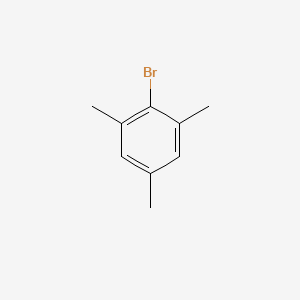
CAS · 576-83-0
Product Overview
2,4,6-Trimethybromombenzene is a high-purity analytical-reagents supplied for industrial and specialty chemical applications. Contact our team for specifications, packaging options and lead times.
Product Specifications
| Appearance | colorless to light yellow liquid |
|---|---|
| Purity | 98% min |
| Water content (K.F.) | 0.5% max |
Applications
2,4,6-Trimethylbromobenzene is a versatile reagent widely used in organic synthesis as a key building block. It serves primarily as a precursor to Grignard reagents-organomagnesium compounds-which are fundamental for forming carbon-carbon bonds in the synthesis of complex molecules. These Grignard reagents derived from 2,4,6-trimethylbromobenzene are applied in pharmaceuticals, agrochemicals, and material science to introduce the mesityl group selectively.
Additionally, this compound is utilized in the preparation of frustrated Lewis pair (FLP) catalysts through its transformation into phosphonium borates. These FLPs enable metal-free catalytic hydrogenation of imines and other substrates, offering environmentally friendly alternatives to conventional metal-based catalysts. Moreover, it is involved in the synthesis of specialty chemicals, dyes, and organic electronic materials due to its unique structural features imparted by the methyl substituents.
Benefits
The main benefits of 2,4,6-trimethylbromobenzene stem from its chemical reactivity and structural properties. The bromine atom provides a highly reactive site for nucleophilic substitution and metalation reactions, facilitating the generation of organometallic intermediates critical in complex organic synthesis. The three methyl groups create steric hindrance that can improve selectivity and stability of the resulting compounds, reducing side reactions and improving yields.
Its role in forming FLP catalysts supports sustainable chemistry by enabling metal-free catalytic processes, which reduce reliance on scarce or toxic metals, lower environmental impact, and often allow milder reaction conditions. The compound's relatively simple synthesis and availability also make it a practical choice for large-scale industrial applications.
Conclusion
2,4,6-Trimethylbromobenzene is a valuable chemical intermediate with broad utility in organic synthesis and catalyst development. Its ability to generate highly reactive intermediates and support green catalytic processes underscores its importance in pharmaceutical manufacturing, materials science, and sustainable chemistry. The combination of reactivity, selectivity, and environmental advantages ensures this compound remains a key component in advancing modern synthetic methodologies.
Previous
Next