
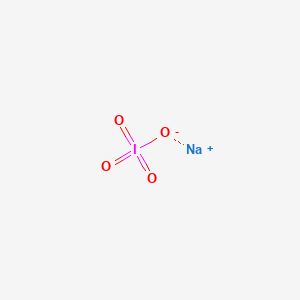
CAS · 7790-28-5
Product Overview
Sodium periodate is a high-purity catalysts-auxiliary-agent supplied for industrial and specialty chemical applications. Contact our team for specifications, packaging options and lead times.
Product Specifications
| Appearance: | White or colorless crystalline powder |
|---|---|
| Assay: | 99.0% min. |
| Iodide: | 0.005% max |
| Other halogens (As Cl): | 0.02% max |
| K: | 0.03% max |
| Mn: | 0.0003% max |
| Clarity test: | No.6 max |
Applications
1. Organic and Synthetic Chemistry
Vicinal Diol Cleavage
Sodium periodate selectively cleaves 1,2-diols (vicinal diols) into two carbonyl compounds (aldehydes or ketones). This makes it a vital reagent in:
Carbohydrate analysis and derivatization
Synthesis of aldehydes/ketones
Fragmentation of sugar backbones
Oxidative Deprotection
It is used for deprotecting certain protective groups in organic molecules, especially when milder and more selective oxidizing conditions are required.
Ring Opening Reactions
Periodate can open rings in sugar structures or polyols during synthesis, aiding in the structural modification of carbohydrates and polyethers.
2. Biotechnology and Bioconjugation
Labeling and Crosslinking of Glycoproteins and Polysaccharides
Sodium periodate is widely used to oxidize cis-diols in sugar moieties, generating reactive aldehyde groups that can be linked with:
Amines (via Schiff base formation)
Hydrazines
Aminooxy-containing reagents
This is crucial in:
Antibody-drug conjugates (ADCs)
Protein labeling and immobilization
Enzyme-linked immunosorbent assays (ELISA)
Biosensor development
PEGylation and Polymer Functionalization
Used to activate PEGs, dextrans, and other polyhydroxylated polymers before further modification or conjugation.
3. Analytical Chemistry
Quantitative Carbohydrate Analysis
Sodium periodate is used to cleave sugars and polyols, enabling determination of sugar structure and molar mass through stoichiometric measurement of periodate consumed.
Oxidative Titrations and Tracing
It serves as an oxidizing agent in redox titrations and trace analyses due to its sharp endpoint and selectivity.
4. Materials Science and Polymer Chemistry
Functionalization of Polysaccharides
In the preparation of oxidized cellulose, alginate, or starch, sodium periodate introduces aldehyde groups, enabling cross-linking or further chemical modification, commonly used in:
Hydrogels
Wound dressings
Tissue engineering scaffolds
Nanomaterials and Biomaterials
Utilized in creating biodegradable polymer carriers for drug delivery by introducing reactive sites for conjugation.
5. Photography and Imaging (Historical Use)
Used in photographic processing for oxidative cleavage and bleach steps, although less common in modern digital photography.
6. Sanitation and Disinfection (Limited Use)
Due to its strong oxidative properties, sodium periodate may be used in specialized disinfection or surface sterilization applications, though not as commonly as other agents like sodium hypochlorite or hydrogen peroxide.
Benefits
✅ High Selectivity
Cleaves only vicinal diols, allowing targeted oxidation without damaging other parts of the molecule.
✅ Mild Reaction Conditions
Operates effectively at room temperature and neutral to slightly acidic pH, making it compatible with sensitive biomolecules like proteins and carbohydrates.
✅ Water Soluble
Easily dissolves in aqueous solutions, simplifying its use in biochemical and polymer chemistry applications.
✅ Efficient Functionalization Tool
Introduces aldehyde groups for downstream conjugation or modification in one step, improving the efficiency of bioconjugation workflows.
✅ Safe Handling Relative to Other Oxidizers
While still an oxidizer, sodium periodate is more stable and less hazardous than some alternatives like osmium tetroxide.
Conclusion
Sodium periodate (CAS 7790-28-5) is a powerful, selective oxidizing agent that plays a vital role in organic synthesis, carbohydrate chemistry, bioconjugation, and polymer modification. Its ability to cleave vicinal diols under mild conditions, combined with its compatibility with aqueous systems and biomolecules, makes it indispensable in research and industrial applications alike. Whether for diagnostic assay development, advanced drug delivery systems, or structural carbohydrate analysis, sodium periodate remains a cornerstone reagent across disciplines.
Previous
Tri(2-aminoethyl)amine丨CAS 4097-89-6
Next