CAS · 10519-96-7
Product Overview
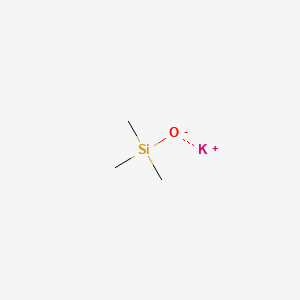
Potassium trimethylsilanolate is a high-purity silicon-compounds supplied for industrial and specialty chemical applications. Contact our team for specifications, packaging options and lead times.
Product Specifications
| Appearance: | white solid |
|---|---|
| Assay(T): | 97% min |
| MP: | 135-138 deg C |
Applications
Potassium trimethylsilanolate (KOSiMe₃) is a strong, non-nucleophilic base and a useful silylating reagent in organic and organometallic chemistry. Its high basicity and unique silicon-centered structure make it valuable for a range of synthetic and industrial purposes:
1. Base in Organic Synthesis
KOSiMe₃ is a powerful, non-nucleophilic base, used in reactions where standard organic bases (e.g., NaOH, K₂CO₃, or organic amines) are not strong or selective enough:
Deprotonation of weakly acidic protons, such as those adjacent to carbonyls or aromatic rings.
Facilitates elimination, condensation, and rearrangement reactions.
Commonly used in:
Ester enolate formation
Silyl enol ether synthesis
Selective deprotection of acid-labile groups
2. Silylation Agent
As a silanolate, it acts as both a nucleophilic silicon source and a base:
Used to introduce trimethylsilyl (TMS) protecting groups onto alcohols, phenols, and carboxylic acids:
ROH + KOSiMe₃ → ROSiMe₃ + KOH
These TMS ethers or esters are useful in:
Protecting group strategies in multi-step organic synthesis
Improving volatility for GC analysis
Altering solubility and reactivity
3. Polymer Chemistry and Silicon-Based Materials
In silicone chemistry, KOSiMe₃ is employed in:
Depolymerization or re-equilibration of polysiloxanes
Initiating polymerization of cyclic siloxanes (such as D₄ or D₅)
End-group modification of siloxane polymers
This makes it useful in manufacturing or modifying:
Silicone elastomers
Surfactants
Water-repellent coatings
Siloxane-based fluids or resins
4. Catalyst or Reagent in Transition-Metal Chemistry
KOSiMe₃ is often used in organometallic synthesis as:
A base to generate metal alkyl or aryl complexes
A ligand modifier when preparing sensitive or reactive metal species
Example: It can deprotonate ligands or stabilize low-valent metal centers in palladium, nickel, and ruthenium complexes.
5. Desilylation Reagent
Interestingly, despite being a silylating reagent, KOSiMe₃ can also assist in cleaving other silyl groups under specific conditions, making it useful in selective deprotection.
6. Applications in Medicinal Chemistry and Agrochemicals
In drug development, KOSiMe₃ is used:
To create TMS-protected intermediates during active pharmaceutical ingredient (API) synthesis.
In reaction screening and optimization, particularly where mild, high-performance bases are needed.
Its use is also noted in the synthesis of fine chemicals, flavor and fragrance compounds, and agrochemical intermediates.
Benefits
Potassium trimethylsilanolate offers several distinct advantages due to its silicon-based structure and strong base character:
1. Strong, Selective Base
Much stronger than alkali hydroxides or alkoxides.
Non-nucleophilic, meaning it doesn't easily attack carbonyls or sensitive electrophilic sites-ideal for base-sensitive substrates.
2. Facilitates Mild and Clean Reactions
Often used in mild, anhydrous conditions (in solvents like THF or toluene).
Produces easily removable byproducts such as potassium salts or silanols.
3. Excellent for Protection Chemistry
Efficient and high-yielding silylation of hydroxyl and carboxylic acid groups.
TMS-protected intermediates are stable, volatile, and easily deprotected, making them ideal for:
GC/MS analysis
Peptide chemistry
Polysaccharide modifications
4. Useful in Silicone Processing
Plays a crucial role in modifying siloxanes, especially in recycling or tailoring properties of silicone oils and elastomers.
Enhances control over molecular weight and end-group functionality.
5. Compatible with Organometallic Systems
Compatible with sensitive transition metal catalysts.
Often used to generate metal-oxygen or metal-silicon bonds, or activate ligands for catalysis.
6. Versatility in Laboratory and Industrial Use
Effective in both small-scale lab synthesis and large-scale manufacturing, including:
Semiconductor and electronics materials
Specialty coatings
Adhesives and lubricants based on siloxane chemistry
Conclusion
Potassium trimethylsilanolate (KOSiMe₃, CAS 10519-96-7) is a powerful, versatile reagent prized in both organic and silicone chemistry. Its primary advantages include:
Strong, selective basicity
Utility in silylation and protection chemistry
Key role in silicone polymer modification
Compatibility with metal catalysts
Clean reaction profiles and mild conditions
As the demand for advanced materials, pharmaceuticals, and high-performance coatings continues to grow, so does the importance of potassium trimethylsilanolate in enabling precise and efficient synthetic transformations.
Previous
1-Bromo-2-(2-methoxyethoxy)ethane丨CAS 54149-17-6
Next