
N,N-Bis(1-naphthalenyl)-N,N-bisphenyl-(1,1-biphenyl)-4,4-diamine
CAS 123847-85-8
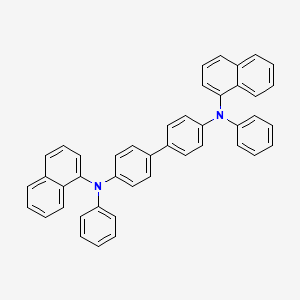
CAS · 123847-85-8
Product Overview
N,N-Bis(1-naphthalenyl)-N,N-bisphenyl-(1,1-biphenyl)-4,4-diamine is a high-purity solar-energy-materials supplied for industrial and specialty chemical applications. Contact our team for specifications, packaging options and lead times.
Product Specifications
| Appearance: | Light yellow powder |
|---|---|
| Purity: | 99.5% min |
| Single impurity of LC: | 5000ppm max |
| Volatile matter: | 1000ppm max |
| Mechanical impurities: | Not detected |
Applications
1. Organic Light-Emitting Diodes (OLEDs)
NPB is primarily used as a hole-transport layer (HTL) in multilayer OLED devices.
Facilitates efficient hole injection from the anode (usually ITO).
Transports holes to the emissive layer while blocking electrons, improving recombination efficiency.
Its HOMO level (~5.4–5.5 eV) aligns well with common OLED electrodes and emissive materials.
Use cases:
Display technologies (TVs, smartphones, tablets)
OLED lighting panels
Flexible and transparent OLED screens
2. Hole Injection/Transport Layers in Other Optoelectronics
NPB is also used in other organic semiconductor devices, such as:
Organic photovoltaic cells (OPVs): as a hole-transport layer.
Organic field-effect transistors (OFETs): for hole transport and injection improvement.
Perovskite solar cells (less common): in device architectures using organic HTLs.
3. Electroluminescent (EL) Devices
Its strong electron-donating character and thermal stability make NPB ideal for EL device fabrication where charge balance and luminescent efficiency are critical.
4. Research in Organic Semiconductors
NPB is widely used as a benchmark material in academic and industrial R&D for:
Studying charge carrier mobility
Device lifetime and degradation studies
Evaluation of new electrode/active layer combinations
Benefits
✅ Excellent Hole Mobility
NPB exhibits good intrinsic hole mobility (on the order of 10⁻³–10⁻⁴ cm²/V·s), ensuring fast and efficient charge transport from the electrode to the emissive layer.
Promotes balanced charge recombination, improving device brightness and efficiency.
✅ Thermal and Morphological Stability
High glass transition temperature (~95–100°C) provides thermal stability, essential for long device lifetimes.
Maintains amorphous morphology during vacuum deposition, preventing crystal formation that could disrupt layer uniformity.
✅ Good Film-Forming Properties
Easily deposited by thermal evaporation.
Forms uniform, pinhole-free films, crucial for defect-free multilayer devices.
✅ Energy Level Compatibility
The HOMO energy level (~5.4 eV) makes it highly compatible with common anodes like ITO and emissive materials like Alq₃ or Ir(ppy)₃.
Reduces energy barriers and improves hole injection efficiency.
✅ Low Optical Absorption in Visible Range
Minimal interference with emitted light from the emissive layer, enhancing brightness and color purity in OLEDs.
✅ Chemical and Photochemical Stability
NPB is relatively stable under operating voltages and illumination, extending the operational lifetime of devices.
Conclusion
N,N-Bis(1-naphthalenyl)-N,N-bisphenyl-(1,1'-biphenyl)-4,4'-diamine (NPB) is a cornerstone material in the field of organic electronics, especially OLED technology. Its role as a hole-transport and injection material is indispensable due to its excellent electrical, thermal, and morphological properties. With strong compatibility with various emissive and electrode materials, NPB remains a go-to material in commercial OLED manufacturing as well as academic research on next-generation optoelectronic devices.
Previous
Next