
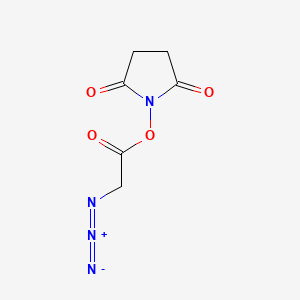
CAS · 824426-32-6
Product Overview
NHS-Ac-N3 is a high-purity pharmaceutical-intermediates supplied for industrial and specialty chemical applications. Contact our team for specifications, packaging options and lead times.
Product Specifications
| Purity | 95% min |
|---|---|
| Appearance | White solid |
| Identification (NMR) | Conforms |
Applications
NHS-Ac-N3 is widely used as a functional reagent in chemical biology and bioconjugation workflows. It is primarily applied for the introduction of azide groups onto biomolecules such as peptides, proteins, and small molecules through efficient amide bond formation with primary amines. This modification enables subsequent click chemistry reactions, particularly strain-promoted or copper-catalyzed azide–alkyne cycloaddition, which are essential in labeling, imaging, and targeted delivery studies. NHS-Ac-N3 is also employed in the preparation of azide-functionalized intermediates for polymer chemistry, surface modification, and material science research, where precise and stable functional group installation is required.
Benefits
NHS-Ac-N3 provides high reactivity and selectivity toward primary amine groups under mild reaction conditions, preserving the structural integrity of sensitive biomolecules. The N-hydroxysuccinimide ester ensures efficient coupling with minimal side reactions, while the acetyl-linked azide group offers excellent stability prior to conjugation. The azide functionality is chemically inert under many conditions, allowing storage and handling without premature reaction, yet it remains highly reactive in click chemistry processes. These properties make NHS-Ac-N3 a reliable and versatile tool for producing well-defined conjugates with high reproducibility and yield, supporting both small-scale research and larger development efforts.
Conclusion
NHS-Ac-N3 is a valuable reagent for introducing azide functionality into amine-containing compounds, enabling a wide range of downstream click chemistry applications. Its efficient coupling behavior, stability, and compatibility with biological systems make it particularly suitable for bioconjugation, labeling, and advanced material design. As demand grows for precise and modular chemical modification strategies, NHS-Ac-N3 continues to play an important role in research and applied chemistry fields.
Previous
Next