CAS · 14965-49-2
Product Overview
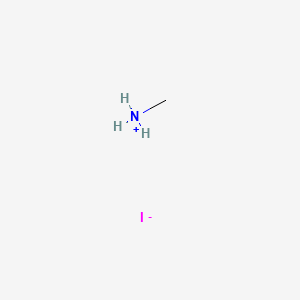
Methylammonium iodide is a high-purity solar-energy-materials supplied for industrial and specialty chemical applications. Contact our team for specifications, packaging options and lead times.
Product Specifications
| Appearance | White crystal |
|---|---|
| Purity | 99.5% min |
Applications
A. Perovskite Solar Cells (PSCs)
The most prominent application of MAI is in the synthesis of perovskite absorber layers for solar cells. When combined with lead iodide (PbI₂), MAI forms methylammonium lead iodide (MAPbI₃), a perovskite material with excellent light-harvesting capabilities.
● Structure Formation: MAI contributes the organic cation to the ABX₃ perovskite structure (A = CH₃NH₃⁺, B = Pb²⁺, X = I⁻).
● High Power Conversion Efficiency (PCE): Devices using MAI-based perovskites have achieved efficiencies exceeding 25%, rivaling conventional silicon-based photovoltaics.
● Solution Processability: MAI enables low-temperature, low-cost solution processing techniques such as spin coating and inkjet printing.
B. Light-Emitting Diodes (LEDs)
Perovskite materials incorporating MAI are used in perovskite LEDs (PeLEDs) due to their tunable emission wavelengths and high photoluminescence quantum yields.
● Color Tunability: By altering the halide composition (e.g., mixing Br⁻ or Cl⁻), MAI-based perovskites can emit across the visible spectrum.
● High Brightness and Efficiency: PeLEDs based on MAI show promising external quantum efficiencies (EQEs), with rapid improvements in device performance.
C. Photodetectors and Imaging Devices
MAI-based perovskites are also applied in photodetectors due to their excellent photoresponsivity and fast response times.
● Broadband Detection: These materials can detect a wide range of wavelengths, from ultraviolet to near-infrared.
● Low-Light Sensitivity: Devices can function effectively under low-light conditions, making them suitable for biomedical imaging and security applications.
D. Thin-Film Transistors and Sensors
Though less mature than photovoltaic applications, MAI-based perovskites are being explored for use in field-effect transistors (FETs), gas sensors, and ion sensors.
● Solution-Processable Electronics: MAI enables the fabrication of flexible and low-cost electronics through wet-chemical synthesis routes.
● Environmental Sensors: Sensitivity to oxygen, humidity, and other gases offers potential for developing perovskite-based chemical sensors.
Benefits
A. Enabling High-Performance Perovskite Materials
Methylammonium iodide丨CAS 14965-49-2 is essential in forming high-quality perovskite crystals with desirable optoelectronic properties:
● Direct Bandgap: MAPbI₃ has a direct bandgap (~1.55 eV), suitable for solar energy conversion and efficient light emission.
● High Absorption Coefficient: Perovskites formed with MAI absorb a broad spectrum of sunlight, increasing photon-to-electron conversion.
● Long Carrier Diffusion Lengths: This contributes to efficient charge collection and reduced recombination losses.
B. Scalability and Low-Cost Processing
MAI facilitates scalable, cost-effective manufacturing methods:
● Solution-Phase Synthesis: MAI can be synthesized from methylamine and hydroiodic acid, offering scalability for industrial production.
● Compatibility with Flexible Substrates: MAI-based perovskites can be processed at relatively low temperatures, allowing deposition on plastic substrates for wearable electronics.
C. Customizability of Material Properties
Through compositional engineering, MAI enables tunability of material characteristics:
● Bandgap Engineering: Substituting or mixing MAI with other organic cations (e.g., formamidinium or cesium) allows tuning of bandgap and stability.
● Stability Enhancement: Though MAPbI₃ has limited environmental stability, blending MAI with other halides or additives improves resilience to heat, moisture, and light exposure.
D. Contribution to Green Energy Solutions
MAI-based perovskite solar cells contribute to the global shift toward renewable energy sources:
● Reduced Carbon Footprint: Compared to silicon photovoltaics, perovskite cells require significantly less energy and material during fabrication.
● Integration into Tandem Devices: MAI-based perovskites are used in tandem configurations with silicon or CIGS cells, achieving higher overall efficiencies (>30%).
Conclusion
Methylammonium iodide丨CAS 14965-49-2 is a cornerstone material in the field of hybrid perovskites, enabling high-performance applications across photovoltaics, LEDs, and sensors. Its benefits in solution processing, tunable material properties, and compatibility with flexible electronics make it a vital component in next-generation optoelectronic devices. With continued innovation addressing its stability and environmental impact, MAI is poised to play a significant role in the sustainable energy landscape of the future.
Previous
Lead(II) Iodide丨CAS 10101-63-0
Next