
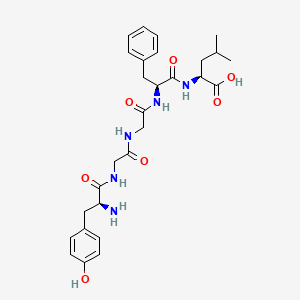
CAS · 58822-25-6
Product Overview
Leucine enkephalin丨CAS 58822-25-6 is an endogenous opioid pentapeptide composed of five amino acids: tyrosine, glycine (twice), phenylalanine, and leucine. It is one of two major types of enkephalins (the other being methionine enkephalin) found in the brain and spinal cord, where it functions as a neurotransmitter and neuromodulator. It plays a key role in pain modulation, emotional regulation, and neurochemical signaling.
Product Specifications
| Appearance | White to off-white powder |
|---|---|
| Identity by ESI-MS | Theoretical MW: 555.62 |
| Purity (by HPLC) | 98% min |
| Water Content | 7% max |
Applications
1. Neuroscience and Pharmacology Research
Opioid Receptor Studies: Leucine enkephalin selectively binds to delta-opioid receptors (DORs), making it a valuable ligand for studying the receptor's pharmacology and function.
Pain Mechanism Exploration: Used in studies investigating the neurochemical basis of analgesia and nociception.
Signal Transduction Research: Assists in understanding G-protein-coupled receptor (GPCR) pathways involved in opioid signaling.
Addiction and Dependence Studies: Helps model the role of endogenous opioids in drug addiction, tolerance, and withdrawal.
2. Analytical Chemistry and Mass Spectrometry
Calibration Standard: Leucine enkephalin丨CAS 58822-25-6 is widely used as a lock-mass reference standard in LC-MS (liquid chromatography-mass spectrometry), especially for instruments such as Waters Q-Tof systems.
Offers consistent and reproducible mass reference at m/z 556.2771 (positive mode) and m/z 554.2615 (negative mode).
Ensures accurate mass calibration, improving reliability and precision in proteomic and metabolomic analyses.
3. Synthetic Biology and Peptide Engineering
Serves as a template peptide for developing peptidomimetic drugs, particularly for designing selective opioid receptor agonists or antagonists with improved stability and efficacy.
Used in studies exploring peptide modifications (e.g., N-terminal acylation or backbone cyclization) to enhance biological activity and resistance to enzymatic degradation.
4. Drug Discovery and Development
Supports the screening and profiling of opioid receptor ligands for analgesic, antidepressant, or anxiolytic drug candidates.
Aids in the rational design of centrally acting pain therapeutics that mimic natural opioid peptides.
Benefits
1. Endogenous Activity
Mimics natural pain-relief mechanisms, contributing to analgesic signaling without necessarily causing strong addictive effects like exogenous opioids (e.g., morphine).
2. High Specificity
Shows selectivity toward delta-opioid receptors, making it a valuable pharmacological tool for receptor subtype differentiation.
3. Analytical Versatility
Serves as a precise mass calibration compound, essential in high-resolution MS applications.
4. Scientific Relevance
Plays a pivotal role in understanding neurobiology, emotion, and pain, as well as in the development of next-generation opioid-based therapies.
Conclusion
A concise summary and suitability assessment for this product is available on request. Contact our team to discuss whether it fits your process and quality requirements.