
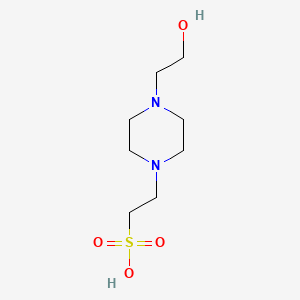
CAS · 7365-45-9
Product Overview
HEPES is a high-purity biological-buffer supplied for industrial and specialty chemical applications. Contact our team for specifications, packaging options and lead times.
Product Specifications
| Appearance | White crystalline powder |
|---|---|
| Assay | 99%~101% |
| Water | 0.5% max |
| Loss on drying | 1% max |
| Melting point | 234~238℃ |
| Solubility (1.0M aqueous) | Colorless, transparent |
| PH (1.0M aqueous) | 6.0~8.0 |
| Cl | 0.05% max |
| SO4 | 0.005% max |
| Pb | 0.0005% max |
| Ultraviolet absorbance/260nm | 0.05 max |
| Ultraviolet absorbance/280nm | 0.03 max |
Applications
1. Biological and Biochemical Research
Buffering agent in cell culture and molecular biology:
Maintains stable pH in biological systems, especially in the physiological range close to pH 7.4
Common in mammalian cell culture media, protein purification, and enzyme assays
2. Cell Culture and Tissue Engineering
Used to stabilize the pH of media during cell growth without the need for CO₂-dependent buffering systems (e.g., bicarbonate buffers).
Essential in sensitive systems where precise pH control is critical, such as stem cells or neuron cultures.
3. Protein and Enzyme Stabilization
Used in protein crystallography, enzyme storage, and biochemical assays to maintain protein structure and function.
4. Diagnostic Kits and Biosensors
Included in clinical diagnostic reagents, PCR kits, and biosensor matrices to ensure reproducible results under near-physiological conditions.
5. Electrophoresis and Chromatography
HEPES-based buffers are used in capillary electrophoresis, gel electrophoresis, and HPLC for biomolecule separation under consistent pH.
6. Medical and Pharmaceutical Research
Employed in drug formulation and delivery systems where physiological pH stability is essential for drug solubility and efficacy.
Benefits
1. Excellent pH Stability
Minimal temperature and concentration dependence, making it superior for long-term and precise biological experiments.
2. Biocompatibility
Non-toxic to cells and does not interfere with most biological reactions, making it ideal for in vitro and in vivo studies.
3. CO₂-Independent Buffering
Unlike bicarbonate buffers, HEPES does not require a CO₂ incubator, allowing greater experimental flexibility.
4. Low Metal Ion Binding
Has low affinity for divalent cations (e.g., Mg²⁺, Ca²⁺), avoiding interference with enzymatic reactions or ion-sensitive assays.
5. Transparent in UV and Visible Light
Does not absorb significantly in the UV-visible spectrum, making it suitable for spectrophotometric assays and imaging applications.
Conclusion
HEPES (CAS 7365-45-9) is a high-performance biological buffer prized for its excellent pH control, biocompatibility, and versatility in cell culture, molecular biology, and biochemical assays. Its ability to maintain physiological pH without CO₂ makes it a preferred choice in modern life science research, diagnostics, and pharmaceutical development.
Previous
3-Morpholinopropanesulfonic Acid丨CAS 1132-61-2
Next
N,N-Bis(2-hydroxyethyl)-2-aminoethanesulfonic Acid丨CAS 10191-18-1