
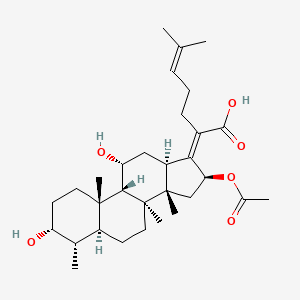
CAS · 6990-06-3
Product Overview
Fusidine is a high-purity a-api supplied for industrial and specialty chemical applications. Contact our team for specifications, packaging options and lead times.
Product Specifications
| Grade | EP10.5 |
|---|---|
| Appearance | White or almost white crystalline powder |
| Assay (Anhydrous) | 97.5% ~ 101.0% |
| Solubility | Practically insoluble in water, freely soluble in ethanol (96%) |
| Identification A (IR) | The infrared spectrum should conform with the fusic acid CRS |
| Identification B (Reaction of sodium) | The residue does not give reaction of sodium |
| Related Substances Impurity M | 1.0% max. |
| Impurity G | 0.7% max. |
| Impurity L | 0.5% max. |
| Impurity B | 0.4% max. |
| Impurity A | 0.3% max. |
| Impurity H | 0.1% max. |
| Impurity C | 0.2% max. |
| Impurity D | 0.2% max. |
| Impurity F | 0.2% max. |
| Impurity I | 0.2% max. |
| Impurity K | 0.2% max. |
| Impurity N | 0.2% max. |
| Main unspecified impurities | 0.1% max. |
| Total impurities | 2.0% max. |
| Water | 1.4% ~ 2.0% |
| Sulfated ash | 0.2% max. |
| Particle size | 90% pass 10 μm by vol |
| Residual Solvents Ethanol | 5000 ppm max. |
| Methanol | 3000 ppm max. |
| Ethyl acetate | 5000 ppm max. |
| N-Hexane | 290 ppm max. |
| Microbial Limit Test Bacteria | 100 cfu/g max. |
| Total molds and yeasts | 10 cfu/g max. |
| Staphylococcus aureus | None |
| Pseudomonas aeruginosa | None |
Applications
Fusidine is widely applied in the treatment of bacterial infections, particularly those caused by Staphylococcus aureus. It is used in topical formulations such as creams and ointments for skin infections, in eye drops for ocular infections, and in oral or injectable forms for deep-seated infections like osteomyelitis, pneumonia, and endocarditis. In clinical practice, it is also employed in combination therapies with other antibiotics to increase treatment effectiveness and reduce bacterial resistance.
Benefits
The primary benefits of Fusidine lie in its strong activity against Gram-positive bacteria, especially resistant strains such as MRSA. It provides excellent tissue penetration, allowing it to reach infections in bones and joints effectively. Its targeted mechanism of action disrupts bacterial protein synthesis without significantly disturbing the normal microbiota. Fusidine is also available in multiple formulations, offering flexibility in treatment, and is generally well tolerated with a favorable safety profile.
Conclusion
Fusidine is an important antibiotic with both topical and systemic applications, offering reliable treatment options for a range of bacterial infections. Its potency against resistant pathogens, combined with its safety and versatility, makes it a valuable therapeutic tool in modern infection management.
Previous
Next