
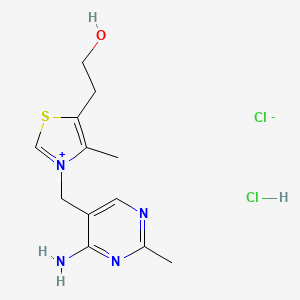
CAS · 67-03-8
Product Overview
Thiamine hydrochloride is a high-purity pharmaceutical-intermediates supplied for industrial and specialty chemical applications. Contact our team for specifications, packaging options and lead times.
Product Specifications
| Grade | USP40 |
|---|---|
| Appearance | White or faintly yellow crystalline powder |
| Assay | 98.0%~102.0% |
| Identification A | Infrared Absorption 〈197K〉 (Dry specimen at 105℃ for 2 hours) |
| Identification B | Chloride test 〈191〉 |
| pH | 2.7–3.4 |
| Water | 5.0% max |
| Residue on ignition | 0.2% max |
| Absorbance of solution | 0.025% max |
| Limit of nitrate | No brown rings |
| Related compounds | 1.0% max |
| Total plate count | 1000 CFU/g max |
| Mold and yeast | 100 CFU/g max |
Applications
In terms of applications, thiamine hydrochloride is commonly incorporated into nutritional supplements, fortified food products, and veterinary feed formulations to support normal metabolic function. It is widely used in pharmaceutical preparations designed to address thiamine deficiency and to support neurological and cardiovascular health. The compound also serves as an important reagent in biochemical research, particularly in studies involving metabolic pathways, enzyme mechanisms, and cofactor interactions. In industrial settings, it is applied in the development of health-supporting formulations, functional beverages, and nutrient blends where stability and solubility are important. Its compatibility with aqueous systems makes it suitable for both solid and liquid formulations across medical, nutritional, and research environments.
Benefits
The benefits of thiamine hydrochloride stem from its high solubility, stability, and biological significance. As a readily absorbable form of thiamine, it helps maintain normal energy metabolism by supporting the conversion of carbohydrates into usable energy. Its contribution to nerve function, cognitive performance, and overall metabolic efficiency makes it valuable in health-related formulations. The hydrochloride form enhances shelf stability and allows precise dosing, ensuring reliable performance in supplements and therapeutics. Additionally, its well-characterized biochemical activity makes it a dependable tool for research applications, enabling reproducible results in enzymatic and metabolic studies.
Conclusion
In conclusion, thiamine hydrochloride is an important compound used across nutrition, pharmaceuticals, and biochemical research. Its applications in supplement formulations, therapeutic products, and metabolic studies, along with benefits such as solubility, stability, and essential biological roles, make it a widely utilized and practical ingredient. The compound supports efficient metabolic function and provides consistent value in both health-related and scientific applications.
Previous
4-Methyl-3-[[4-(3-pyridinyl)-2-pyrimidinyl]amino]benzoic Acid丨CAS 641569-94-0
Next