
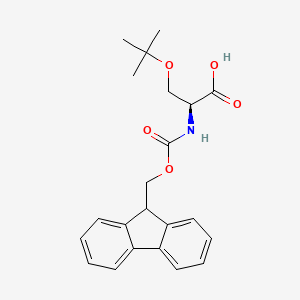
CAS · 71989-33-8
Product Overview
Fmoc-O-tert-Butyl-L-serine is a high-purity pharmaceutical-intermediates supplied for industrial and specialty chemical applications. Contact our team for specifications, packaging options and lead times.
Product Specifications
| Item | Specification |
|---|---|
| Appearance | White powder |
| Purity (HPLC) | 99% min |
| Optical Purity | 0.3% max D-enantiomer |
| TLC | 98% min |
| Melting Point | 125~140℃ |
| Specific Rotation [α]20D | +25° ±2.5° (C=1 in EtOAc) |
| Clarity of Solution | 0.3 gram in 2ml DMF clear solution |
| Water Content (K.F.) | 1.0% max |
| Loss on Drying | 1.0% max (60°C, 2h) |
| Element Analysis (C, H, N) | 5% max |
| Kaiser Test | 0.05% max |
| IR | In accordance with the structure |
| Mass Spectrum | In accordance with the structure |
| NMR Spectrum | In accordance with the structure |
Applications
1. Solid-Phase Peptide Synthesis (SPPS)
● Fmoc-O-tert-Butyl-L-serine丨CAS 71989-33-8 is frequently used in the synthesis of peptides, especially when the serine residue needs to be protected during the assembly of longer peptide sequences.
● The Fmoc group protects the amine group, allowing selective deprotection to form peptide bonds. The tert-butyl ester of serine prevents unwanted reactions at the hydroxyl group during peptide assembly.
● Used in high-throughput peptide synthesis, where selectivity and efficiency are crucial for building peptides.
2. Peptide and Protein Synthesis
● Employed to synthesize peptides that contain serine residues in biological and pharmaceutical research. This includes peptides that require post-translational modifications or peptides involved in cell signaling or enzymatic activity.
● Utilized in the preparation of phosphorylated peptides, as serine is often the target of phosphorylation in cellular processes.
3. Chemical and Biochemical Research
● Fmoc-O-tert-Butyl-L-serine is a tool in the development of peptide-based drugs and other therapeutic agents.
● It is also used for the creation of peptide mimetics and drug delivery systems.
4. Development of Enzyme Inhibitors
● This protected form of serine can be used in enzymatic studies, particularly for designing inhibitors that target serine proteases or kinases.
● Serine proteases, in particular, are involved in a variety of biological processes and diseases, and designing inhibitors with such peptides is an important area of drug discovery.
5. Antibody and Vaccine Development
● Used to synthesize antigenic peptides for the development of antibodies or vaccines, especially those that contain post-translational modifications such as phosphorylation.
● Serine-containing peptides are often involved in immune response modulation.
Benefits
√ High Selectivity in Peptide Synthesis
● The Fmoc protection group is widely used for its ease of removal under mild basic conditions (e.g., piperidine), allowing for controlled peptide assembly.
● The tert-butyl ester protects the hydroxyl group in serine, ensuring that serine's reactivity is minimal during the synthesis process.
√ Stability and Ease of Handling
● Both the Fmoc group and tert-butyl ester provide excellent stability, allowing for extended handling times during peptide synthesis without the risk of premature deprotection.
√ Prevention of Side Reactions
● Protecting the hydroxyl group of serine with a tert-butyl group minimizes unwanted reactions that could occur at the hydroxyl site, particularly when synthesizing complex peptides.
√ Flexibility for Modifications
● This protected amino acid is versatile and can be easily incorporated into longer peptide sequences with different types of modifications.
● It is used in the development of peptides with phosphorylation or other modifications on serine.
√ Widely Applicable in Research
● Extensively used in academic and industrial laboratories for research in biochemistry, pharmaceutical development, and chemical biology.
● Ideal for creating targeted peptides for drug design and therapy development.
Conclusion
Fmoc-O-tert-Butyl-L-serine丨CAS 71989-33-8 is an essential protected amino acid used in solid-phase peptide synthesis (SPPS) and peptide-based research. Its selectivity, stability, and ability to protect serine's hydroxyl group during peptide synthesis make it invaluable for generating peptides with serine residues. Its applications extend from biological research to drug development, particularly in the areas of peptide therapeutics and enzymatic studies.
Previous
Nadide Phosphate Monosodium丨CAS 1184-16-3
Next
Conclusion
A concise summary and suitability assessment for this product is available on request. Contact our team to discuss whether it fits your process and quality requirements.