CAS · 4301-14-8
Product Overview
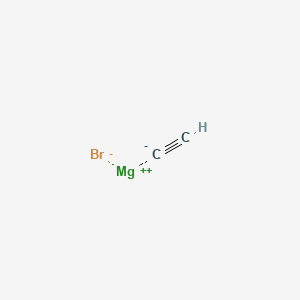
Ethynylmagnesium bromide is a high-purity grignard-reagent supplied for industrial and specialty chemical applications. Contact our team for specifications, packaging options and lead times.
Product Specifications
| Appearance: | Gray to brown liquid |
|---|---|
| Concentration: | 0.45M–0.60M |
| Assay: | 6.0%–8.0% |
Applications
1. Nucleophilic Addition to Carbonyl Compounds
Reacts with aldehydes and ketones to form propargylic alcohols after protonation.
Example: HC≡CMgBr + RCHO → RCH(OH)C≡CH
Enables the synthesis of alkyne-containing alcohols, important intermediates for further functionalization.
2. Synthesis of Alkynes and Functionalized Derivatives
Acts as a nucleophile to generate alkyne-substituted molecules, which serve as precursors for complex natural products, pharmaceuticals, and specialty chemicals.
3. Cross-Coupling Reactions
Used as a nucleophilic partner in Sonogashira and related coupling reactions after transformation.
Enables formation of C(sp)-C(sp²) bonds, valuable in building conjugated systems.
4. Building Blocks in Click Chemistry
The ethynyl group introduced via this reagent can be further utilized in click reactions (e.g., azide-alkyne cycloaddition), widely used in chemical biology and materials science.
5. Synthesis of Heterocycles
Propargylic alcohols and alkynes derived from ethynylmagnesium bromide serve as intermediates in constructing heterocyclic compounds.
Benefits
1. Introduction of Alkyne Functionality
Provides a direct route to install the terminal alkyne group, a versatile handle for diverse chemical transformations.
2. High Reactivity and Selectivity
Efficiently reacts with various electrophiles under mild conditions, yielding high purity products.
3. Versatility
The ethynyl group is a key intermediate for functionalization, cycloadditions, and cross-couplings, enhancing synthetic routes.
4. Facilitates Modular Synthesis
Enables building block approach to complex molecules via alkyne chemistry.
Conclusion
Ethynylmagnesium bromide (CAS 4301-14-8) is a vital Grignard reagent for the introduction of terminal alkyne groups into organic molecules via nucleophilic addition to electrophiles. Its utility spans the synthesis of propargylic alcohols, cross-coupling intermediates, and heterocyclic compounds, providing a foundation for complex molecule assembly in pharmaceuticals, materials science, and chemical biology. Its high reactivity, selectivity, and versatility make it an indispensable reagent in modern organic synthesis.
Previous
Next