
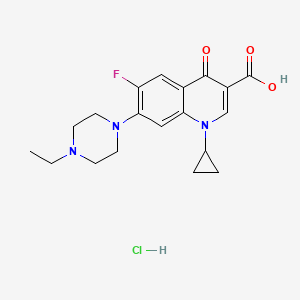
CAS · 112732-17-9
Product Overview
Enrofloxacin hydrochloride is a high-purity veterinary-medicine supplied for industrial and specialty chemical applications. Contact our team for specifications, packaging options and lead times.
Product Specifications
| Appearance: | White or almost white crystalline powder, practically odorless and bitter |
|---|---|
| Assay (C19H22FN3O3): | 89.5%~92% (dried substance) |
| Assay (C19H22FN3O3·HCl): | 98.5% (dried substance) |
| Identification (1) Bismuth potassium iodide solution test: | Should generate orange-red precipitate |
| (2) Malonic acid/acetic anhydride test: | Solution shows brownish-red colour |
| (3) HPLC: | The retention time of the principal peak corresponds to that of the standard |
| (4) IR: | Conforms to the reference spectrum |
| (5) Chloride identification: | Responds to identification tests for chloride |
| Clarity / Color of solution: | Clear and not more intensely coloured than Y4 or YG4 |
| pH (0.1g/10mL water): | 3.5~4.5 |
| Fluoroquinolonic acid: | 0.2% max |
| Loss on drying (105°C): | 0.5% max |
| Heavy metals: | 20 ppm max |
| Residue on ignition: | 0.2% max |
| Related substances (HPLC) Ciprofloxacin: | 0.5% max |
| Any other single impurity: | 0.3% max |
| Total impurities: | 0.7% max |
Applications
1. Veterinary Antibiotic
Enrofloxacin hydrochloride is used exclusively in animals, especially:
Livestock: cattle, pigs, sheep, goats
Poultry: chickens, turkeys, ducks
Aquaculture: fish and shrimp
Companion animals: dogs and cats
2. Treatment of Bacterial Infections
Commonly treated conditions include:
Respiratory infections (e.g. pneumonia, bronchitis)
Urinary tract infections
Skin and wound infections
Gastrointestinal infections (e.g. colibacillosis, salmonellosis)
Septicemia
Otitis externa/interna in pets
Foot rot in livestock
3. Prophylactic Use in Intensive Farming
Used in preventive strategies (with restrictions in some regions) to control outbreaks, especially in:
Poultry farms (e.g., for E. coli and Mycoplasma spp.)
Swine operations (e.g., for Actinobacillus or Pasteurella)
Fish farms (e.g., Aeromonas, Vibrio)
Benefits
1. Broad-Spectrum Activity
Effective against Gram-negative (e.g., E. coli, Pasteurella, Salmonella, Pseudomonas) and Gram-positive bacteria (e.g., Staphylococcus, Streptococcus)
Also effective against Mycoplasma and some Rickettsia
2. High Oral Bioavailability
Rapid absorption via oral administration
Reaches therapeutic levels quickly in bloodstream and tissues
3. Excellent Tissue Penetration
Accumulates in infected tissues and organs, including lungs, kidneys, liver, and bones
Especially effective in deep or systemic infections
4. Long-Lasting Effects
Long half-life allows for once-daily dosing
Reduces handling stress for animals and improves compliance in farm settings
5. Cost-Effective Veterinary Solution
Reduces animal morbidity and mortality
Enhances growth performance by minimizing illness (indirect benefit)
6. Versatile Formulation
Available in various dosage forms:
Oral solutions
Injections
Tablets (for pets)
Medicated feed premixes
Conclusion
Enrofloxacin hydrochloride (CAS 112732-17-9) plays a vital role in veterinary antimicrobial therapy, offering broad-spectrum, fast-acting, and deep-tissue protection against numerous bacterial infections. Its convenience and effectiveness make it widely used in both companion and food-producing animals. However, responsible use is critical to prevent antibiotic resistance, protect public health, and maintain its efficacy in the long term.
Previous
Next