
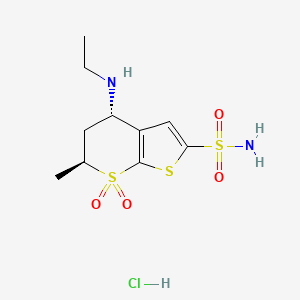
CAS · 130693-82-2
Product Overview
Dorzolomide hydrochloride is a high-purity a-api supplied for industrial and specialty chemical applications. Contact our team for specifications, packaging options and lead times.
Product Specifications
| Appearance | A white crystalline powder |
|---|---|
| Assay | 99.0%~101.0% |
| Identification | IR/HPLC |
| Solubility | 1g sample dissolve in 10~30 mL of water |
| Appearance of solution | Clear and colorless |
| Water content | Not more than 0.5% (using 0.4g) |
| Heavy metals | Not more than 0.001% |
| Residue on ignition | Not more than 0.1% |
| Purity | Not less than 99.5% |
| Individual impurity | Not more than 0.1% |
| Total impurities | Not more than 0.5% |
| Chiral purity (ee) | Not less than 99.0% |
| Related compound A | Not more than 0.5% |
| Residual Solvents | Methanol: Not more than 3000 ppm Ethyl acetate: Not more than 5000 ppm Tetrahydrofuran: Not more than 720 ppm |
| Compliance | The material complies with the specification USP 32 |
Applications
Dorzolamide hydrochloride (CAS 130693-82-2) is a pharmaceutical compound primarily used in ophthalmology as an active ingredient in anti-glaucoma medications. Its main application is to reduce elevated intraocular pressure (IOP) in patients with open-angle glaucoma or ocular hypertension. Dorzolamide hydrochloride functions as a carbonic anhydrase inhibitor, decreasing the production of aqueous humor in the eye, which in turn lowers IOP. It is commonly formulated as an ophthalmic solution, either as a standalone therapy or in combination with other agents such as beta-blockers, to provide enhanced control of intraocular pressure. Its topical administration allows localized action with minimal systemic exposure.
Benefits
The benefits of Dorzolamide hydrochloride are directly associated with its efficacy, safety, and tolerability in managing elevated intraocular pressure. By selectively inhibiting carbonic anhydrase in the ciliary processes of the eye, it provides effective IOP reduction, helping to prevent optic nerve damage and preserve vision in glaucoma patients. Topical administration minimizes systemic side effects compared to oral carbonic anhydrase inhibitors, making it suitable for long-term therapy. It also complements other ocular medications, offering synergistic effects in combination therapies for better disease management. Its stability and compatibility with ophthalmic formulations ensure consistent therapeutic performance and patient adherence.
Conclusion
In conclusion, Dorzolamide hydrochloride is an important anti-glaucoma agent used to lower intraocular pressure and protect vision in patients with glaucoma or ocular hypertension. Its targeted mechanism, efficacy, and tolerability make it a valuable option in ophthalmic care. By enabling effective disease management and supporting long-term ocular health, Dorzolamide hydrochloride plays a critical role in modern glaucoma therapy.
Previous
Next