CAS · 609-36-9
Product Overview
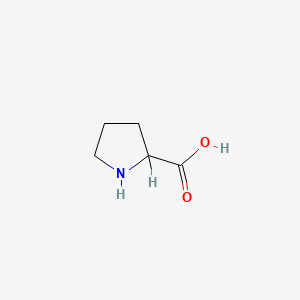
DL-Proline is a high-purity food-additives supplied for industrial and specialty chemical applications. Contact our team for specifications, packaging options and lead times.
Product Specifications
| Appearance: | A white to off-white powder |
|---|---|
| Assay: | 98% to 101% |
| Specific rotation [α]D20: | -1° to +1° |
| Chloride (Cl): | 0.02% max |
| Heavy metals (Pb): | 10 ppm max |
| Arsenic (As2O3): | 2 ppm max |
| Loss on drying: | 0.5% max |
| Residue on ignition: | 0.2% max |
Applications
1. Chemical Synthesis and Catalysis
Used as an organocatalyst in asymmetric synthesis, particularly in aldol reactions and Michael additions.
Facilitates stereoselective formation of carbon–carbon bonds due to its chiral structure.
A racemic mixture (DL-form) is cost-effective for non-stereospecific reactions where chirality is not critical.
2. Biochemical Research
Serves as a model compound for studying protein folding and conformational analysis.
DL-proline is useful in testing enzymes that act specifically on one enantiomer (L- or D-proline), helping elucidate enzyme stereospecificity.
3. Pharmaceutical and Peptide Chemistry
Used in the synthesis of proline-containing peptides and peptide mimetics.
Plays a role in the design of proline analogues for modulating peptide conformation and stability.
4. Polymer and Material Science
Utilized in the preparation of biodegradable polymers and as a monomer in protein-based biomaterials.
Has applications in gel formation and coating materials.
Benefits
Versatile chemical intermediate for stereoselective and racemic applications.
Cost-effective alternative to optically pure L- or D-proline.
Stable and easy to handle, with good solubility in water and polar solvents.
Compatible with green chemistry approaches in organocatalysis.
Conclusion
A concise summary and suitability assessment for this product is available on request. Contact our team to discuss whether it fits your process and quality requirements.