
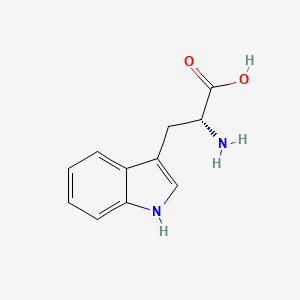
CAS · 153-94-6
Product Overview
D(+)-Tryptophan is a high-purity nutrient-additives supplied for industrial and specialty chemical applications. Contact our team for specifications, packaging options and lead times.
Product Specifications
| Grade: | Company standard |
|---|---|
| Appearance: | White to yellowish crystalline |
| Assay (HPLC): | 99.0 to 101.0% |
| Identification: | HPLC retention time correspond to WRS under assay item |
| Specific rotation [α]D20: | +30.5°~ +32.5° |
| Loss on drying: | 0.50% max |
| Residue on ignition: | 0.10% max |
| PH: | 5.4~6.4 |
| Chloride (Cl): | 0.02% max |
| Ammonium (NH₄): | 0.02% max |
| Iron (Fe): | 20 ppm max |
| Heavy metals (Pb): | 10 ppm max |
| Isomer purity (HPLC): | 0.2% max |
| Related substances (HPLC): | |
| Purity: | 98.5% min |
| Single impurity: | 0.5% max |
| Total impurities: | 1.5% max |
Applications
1. Pharmaceutical and Biomedical Research
A. Chirality Studies
● Used in stereochemical studies to compare the biological activity of L- vs D-tryptophan.
● D(+)-Tryptophan丨CAS 153-94-6 helps in understanding enzyme-substrate specificity and protein-ligand interactions.
B. Drug Development
● Serves as a building block in the synthesis of peptidomimetics and D-amino acid-containing drugs due to its resistance to enzymatic degradation.
● Sometimes incorporated into therapeutic peptides to improve stability and half-life.
2. Nutritional and Clinical Applications
A. Diagnostic Marker
● Used as a reference standard in metabolic and nutritional studies, particularly in identifying D-amino acids in biological samples.
● May help in microbial profiling since certain bacteria produce D-tryptophan.
B. Gut Microbiota Studies
● D-tryptophan is known to be produced by certain probiotic and commensal bacteria.
● Research indicates it may play a role in modulating the immune system and maintaining gut homeostasis.
3. Biochemical and Analytical Use
A. Substrate for Enzymatic Reactions
● Serves as a substrate or inhibitor in enzymatic assays involving tryptophanase or amino acid oxidase.
● Used in kinetic and mechanistic studies of amino acid metabolism.
B. Chiral Resolution and Separation
● Acts as a standard or agent in chiral chromatography, especially for testing the selectivity of columns in separating enantiomers.
4. Industrial and Synthetic Chemistry
● Utilized in the synthesis of chiral intermediates, fine chemicals, and bioactive molecules.
● Plays a role in biocatalysis where chirality is crucial to function and activity.
5. Academic and Laboratory Research
● A valuable tool for research in stereochemistry, amino acid metabolism, and peptide chemistry.
● Often used in modeling studies to examine the structure-function relationship of proteins and receptors.
Benefits
√ Enhanced Stability
● More resistant to enzymatic breakdown than the L-form, making it suitable for peptide drugs and research
√ Supports Microbiome and Immune Research
● Involved in studies on microbial metabolites and their effects on host health
√ Chiral Purity and Analytical Utility
● Widely used in chirality determination, enantiomeric purity testing, and method development
√ Synthetic Flexibility
● Serves as a versatile precursor for peptide and pharmaceutical synthesis
Conclusion
D(+)-Tryptophan丨CAS 153-94-6 is a specialty chiral amino acid with broad relevance in research, pharmaceutical development, and metabolic studies. While less common than its L-isomer, the D-form is vital for studying protein-ligand interactions, bacterial metabolism, and drug stability. Its unique properties make it an important tool in both academic research and industrial applications, particularly in areas where chiral specificity and metabolic resistance are essential.
Previous
Next
Conclusion
A concise summary and suitability assessment for this product is available on request. Contact our team to discuss whether it fits your process and quality requirements.