
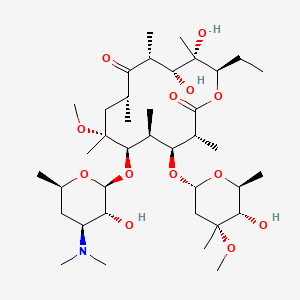
CAS · 81103-11-9
Product Overview
Clarithromycin is a high-purity a-api supplied for industrial and specialty chemical applications. Contact our team for specifications, packaging options and lead times.
Product Specifications
| Appearance: | White to off-white, crystalline powder |
|---|---|
| Infrared absorption: | Corresponds to RS |
| Liquid phase identification: | Retention time of the main peak of the test solution should match the reference solution |
| Optical rotation: | -94° ~ -102° |
| Crystallinity: | Meets the requirement |
| pH: | 8.0 ~ 10.0 |
| Water: | 2.0% max |
| Related substances (HPLC): Impurity I: | 1.0% max |
| Impurity A: | 1.0% max |
| Impurity J: | 1.0% max |
| Impurity L: | 1.0% max |
| Impurity B: | 1.0% max |
| Impurity M: | 1.0% max |
| Impurity C: | 1.0% max |
| Impurity D: | 1.0% max |
| Impurity N: | 1.0% max |
| Related compound A: | 1.0% max |
| Impurity F: | 1.0% max |
| Impurity P: | 1.0% max |
| Impurity O: | 1.0% max |
| Impurity K: | 1.0% max |
| Impurity G: | 1.0% max |
| Impurity H: | 1.0% max |
| Any other individual impurity: | 1.0% max |
| Impurities exceed 0.4%: | 4 max |
| Total impurity: | 3.5% max |
| Residue on ignition: | 0.2% max |
| Assay (HPLC, on anhydrous basis): | 96.0 ~ 102.0% |
| Additional test – Residual solvent (GC): Dichloromethane: | 600 ppm max |
| Ethanol: | 5000 ppm max |
| Methanol: | 3000 ppm max |
| Acetic acid: | 5000 ppm max |
Applications
1.1 Respiratory Tract Infections
Clarithromycin is commonly used for treating upper and lower respiratory tract infections. These include:
Pharyngitis and tonsillitis (primarily caused by Streptococcus pyogenes)
Acute bacterial sinusitis
Acute exacerbations of chronic bronchitis (AECB)
Community-acquired pneumonia (CAP)
Its efficacy against common respiratory pathogens like Streptococcus pneumoniae, Haemophilus influenzae, and Moraxella catarrhalis makes it an important drug in outpatient care settings.
1.2 Skin and Soft Tissue Infections
Clarithromycin treats mild to moderate skin and soft tissue infections, such as:
Cellulitis
Impetigo
Erysipelas
It is effective particularly against Staphylococcus aureus and Streptococcus pyogenes, especially in patients allergic to penicillin.
1.3 Helicobacter pylori Eradication
One of the major advances with clarithromycin was its use in triple therapy for Helicobacter pylori infection, which is linked to peptic ulcers and gastric cancer. Clarithromycin, in combination with a proton pump inhibitor (e.g., omeprazole) and another antibiotic (e.g., amoxicillin or metronidazole), is standard for eradicating H. pylori.
1.4 Mycobacterial Infections
Clarithromycin is highly effective in the treatment and prophylaxis of:
Disseminated Mycobacterium avium complex (MAC) infections in HIV/AIDS patients
Pulmonary infections caused by Mycobacterium kansasii or Mycobacterium abscessus
It is a cornerstone in nontuberculous mycobacterial (NTM) therapy due to its intracellular activity and good tissue penetration.
1.5 Otitis Media
In children and adults, clarithromycin is used to treat:
Acute otitis media (AOM)
Chronic suppurative otitis media, especially where resistance to other antibiotics or allergies limit treatment choices.
1.6 Dental Infections
Clarithromycin may be prescribed for dental abscesses and periodontitis due to its penetration into gingival tissue and bone.
1.7 Off-Label Uses
While not officially approved, clarithromycin has been explored in:
Treatment of rosacea, due to its anti-inflammatory properties
Rheumatoid arthritis and chronic sinusitis, where bacterial persistence and inflammation coexist
Benefits
2.1 Broad Spectrum of Activity
Clarithromycin is active against both Gram-positive and Gram-negative bacteria, including atypical pathogens like:
Mycoplasma pneumoniae
Chlamydophila pneumoniae
Legionella pneumophila
This makes it highly versatile for empirical treatment.
2.2 Good Oral Bioavailability
Clarithromycin has high oral bioavailability (~55%) and is available in tablets, extended-release formulations, and oral suspensions. This allows flexible dosing and convenient outpatient use.
2.3 Improved Acid Stability
Unlike erythromycin, clarithromycin is stable in acidic environments, leading to:
Reduced gastrointestinal side effects
Better absorption
Improved patient compliance
2.4 Anti-Inflammatory and Immunomodulatory Effects
Studies have demonstrated that clarithromycin exhibits:
Inhibition of cytokine production
Reduction in neutrophil recruitment
Decreased mucus secretion
These effects are beneficial in chronic respiratory diseases like COPD and diffuse panbronchiolitis, where inflammation plays a central role.
2.5 Tissue Penetration and Intracellular Activity
Clarithromycin achieves high concentrations in tissues and cells, making it effective against intracellular pathogens such as Chlamydia and Mycobacteria. This also supports its efficacy in deep-seated infections.
2.6 Dual Action in H. pylori Therapy
In H. pylori eradication, clarithromycin not only kills the bacteria but also reduces inflammation in the gastric mucosa, promoting ulcer healing.
2.7 Reduced Frequency of Dosing
The extended-release version of clarithromycin allows once-daily dosing, improving adherence, especially in long-term treatments like MAC prophylaxis or H. pylori therapy.
Conclusion
Clarithromycin (CAS 81103-11-9) is a valuable and versatile macrolide antibiotic used globally for:
Respiratory tract infections
Skin and soft tissue infections
H. pylori eradication
Mycobacterial diseases
Otitis media and dental infections
Its benefits include broad-spectrum activity, good tissue penetration, intracellular efficacy, and anti-inflammatory properties. With both oral and extended-release formulations, clarithromycin remains an essential antibiotic in modern clinical practice.
Previous
Sitagliptin HCL Monohydrate丨CAS 862156-92-1
Next