
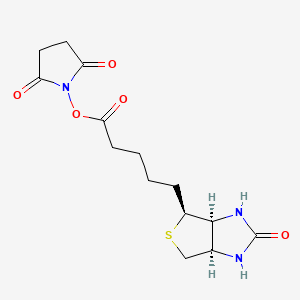
CAS · 35013-72-0
Product Overview
(+)-Biotin N-hydroxysuccinimide ester is a high-purity pharmaceutical-intermediates supplied for industrial and specialty chemical applications. Contact our team for specifications, packaging options and lead times.
Product Specifications
| Appearance | White solid |
|---|---|
| ¹H NMR Spectrum | Consistent with Structure |
| Purity | 97% min |
| Residue content | 0.2% max |
| Structure | Compliant with the structure |
Applications
(+)-Biotin N-hydroxysuccinimide ester is a widely used bioconjugation reagent in the fields of biochemistry, molecular biology, and diagnostic research. It is primarily employed for the attachment of biotin to a broad range of biomolecules, including proteins, peptides, antibodies, enzymes, and nucleic acids. By forming stable amide bonds with primary amines, it enables the introduction of a biotin tag that can be recognized by streptavidin or avidin-based detection systems. This makes it an essential tool for affinity-based assays such as ELISA, Western blotting, immunoprecipitation, and pull-down experiments. In addition to analytical applications, it is used in the creation of biotinylated probes for imaging, flow cytometry, and fluorescence-based assays, allowing for the precise detection, quantification, and localization of biomolecules. Its role extends to targeted drug delivery systems, surface immobilization of biomolecules on microarrays, and the preparation of biotin-labeled nanoparticles for research in nanobiotechnology. The compound is particularly valuable in high-throughput screening, where reproducible and site-specific labeling of proteins and peptides is critical for assay accuracy.
Benefits
The main benefits of (+)-Biotin N-hydroxysuccinimide ester arise from its high reactivity, specificity, and versatility. The NHS ester group reacts selectively with primary amines under mild conditions, which allows for efficient biotinylation without compromising the structural integrity or biological activity of sensitive biomolecules. This selectivity minimizes side reactions and ensures consistent labeling at target sites, which is crucial for quantitative assays and functional studies. The reagent is also soluble in a variety of organic solvents and aqueous buffers, offering flexibility in experimental design and compatibility with a wide range of biomolecular systems. Its ability to produce stable biotin conjugates facilitates strong and specific binding to streptavidin or avidin, enhancing the sensitivity and reproducibility of detection assays. Furthermore, its stability under appropriate storage conditions ensures long shelf life and reliable performance in repeated experiments. The combination of rapid reaction kinetics, minimal interference with biological activity, and broad applicability across proteins, peptides, nucleic acids, and polymers makes this compound an indispensable tool in modern molecular biology, diagnostics, and biotechnology research.
Conclusion
(+)-Biotin N-hydroxysuccinimide ester is a highly versatile and reliable reagent for the selective and efficient biotinylation of biomolecules. Its ability to form stable amide linkages with primary amines, coupled with high specificity and mild reaction conditions, enables the preparation of biotin-tagged molecules that retain biological functionality. The compound supports a wide range of applications, including affinity-based detection, imaging, protein and peptide labeling, drug delivery, and the construction of bioconjugates for research and diagnostic purposes. Its chemical stability, solubility, and reproducible performance make it an essential reagent in laboratories and industrial settings alike, facilitating advanced studies in biochemistry, molecular biology, diagnostics, and biotechnology. By enabling precise biomolecule modification and highly sensitive detection, it plays a critical role in advancing both fundamental research and applied life science technologies.
Previous
1,4-Dibromo-2,5-dimethylbenzene丨CAS 1074-24-4
Next