
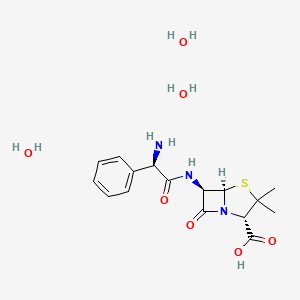
CAS · 7177-48-2
Product Overview
Ampicillin is a high-purity pharmaceutical-intermediates supplied for industrial and specialty chemical applications. Contact our team for specifications, packaging options and lead times.
Product Specifications
| Appearance: | White crystalline powder |
|---|---|
| Assay (C16H19N3O4S): | 96% min |
| Identification: | (1) In the chromatogram recorded under the content determination item, the retention time of the main peak of the test solution should be consistent with that of the main peak of the reference solution (2) The infrared absorption spectrum of the test sample should be consistent with the reference spectrum (spectrum set 658) |
| Water: | 12 to 15% |
| Specific rotation: | +280° to +305° |
| Acid Value: | 3.5 to 5.5 |
| Clarity of solution: | Turbidity standard solution No.2 max (1mol/L hydrochloric acid solution) Turbidity standard solution No.2 max (2mol/L ammonium hydroxide solution) |
| N,N-Dimethylaniline: | 20ppm max |
| Heavy metals: | 20ppm max |
| Residual solvents: | Acetone: 0.5% max Methylene chloride: 0.06% max |
| Residue on ignition: | 0.5% max |
| Related substances: | Biggest impurities: 1.0% max Amount of impurities: 3.0% max |
Applications
1. SO₂ Equivalent in Organic Synthesis
Primary use: It serves as a bench-stable, solid source of sulfur dioxide (SO₂) in synthetic chemistry.
Offers a safer and more convenient alternative to gaseous SO₂, which is toxic and difficult to handle.
Reacts with nucleophiles (such as organolithiums or Grignard reagents) to generate sulfinates, sulfones, and sulfonamides.
2. Sulfonylation Reactions
Used to introduce sulfone and sulfonamide functional groups in pharmaceuticals, agrochemicals, and specialty materials.
Ideal in reactions involving sulfonyl radicals or intermediates for the construction of more complex molecules.
3. Radical Chemistry
Can participate in radical-based processes to generate sulfonyl-containing heterocycles or chains, often under mild photochemical or redox conditions.
Suitable for transition-metal-catalyzed cross-coupling involving SO₂ insertion (e.g., with aryl halides and amines).
4. Medicinal Chemistry and Drug Design
Sulfonyl-containing structures are common in active pharmaceutical ingredients (APIs), and this compound aids in their construction efficiently.
Used in the synthesis of bioactive sulfonylated heterocycles, sulfonamides, and sulfones, which are core motifs in antibiotics, antitumor agents, and enzyme inhibitors.
Benefits
✅ Stable and Easy to Handle
Unlike gaseous SO₂, this compound is a crystalline solid and easier to weigh, store, and use in lab-scale and industrial settings.
✅ High Reactivity with Organometallics
Efficiently reacts with nucleophiles like organolithiums and Grignards, enabling diverse synthetic transformations.
✅ Selective Sulfonylation
Enables high control in the insertion of SO₂, minimizing side products compared to traditional sulfonation methods.
✅ Applicable in Green Chemistry
Avoids the use of corrosive and volatile SO₂ gas.
Can be used under milder conditions with less hazardous waste.
Conclusion
1,5,2,4-Dioxadithiane 2,2,4,4-tetraoxide (CAS 99591-74-9) is a powerful and versatile reagent used primarily as a solid, bench-stable SO₂ surrogate in organic synthesis. It allows for safer, more efficient sulfonylation reactions without the need to handle toxic sulfur dioxide gas. This makes it particularly attractive in pharmaceutical and agrochemical industries for the synthesis of sulfone- and sulfonamide-containing molecules. Its applications in modern organic and radical chemistry continue to expand, offering synthetic chemists a valuable tool for building sulfur-containing compounds.
Previous
3-Nitrophenylhydrazine Hydrochloride丨CAS 636-95-3
Next