
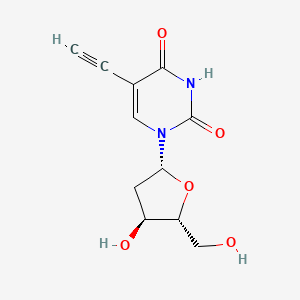
CAS · 61135-33-9
Product Overview
5-Ethynyl-2-deoxyuridine is a high-purity fluorescein supplied for industrial and specialty chemical applications. Contact our team for specifications, packaging options and lead times.
Product Specifications
| Appearance | White to pale yellow powder |
|---|---|
| Purity | 98% min |
| Loss on drying | 1.0% max |
Applications
5-Ethynyl-2-deoxyuridine is primarily used in biochemical and cellular research as a nucleoside analog for studying DNA synthesis and cell proliferation. It is widely applied in labeling newly synthesized DNA, allowing visualization and quantification of DNA replication in cultured cells and tissue samples. The compound is incorporated into DNA in place of thymidine, and its ethynyl group enables selective detection via click chemistry reactions with fluorescent or affinity tags. It is used in assays for cell cycle analysis, cancer research, drug screening, and developmental biology studies. Additionally, it serves as a tool for investigating DNA repair, replication dynamics, and the effects of various treatments on proliferating cells in both research and preclinical experimental settings.
Benefits
5-Ethynyl-2-deoxyuridine provides significant advantages due to its specific incorporation into DNA and compatibility with click chemistry labeling. Its ethynyl group allows rapid, highly selective conjugation to fluorescent probes without the need for harsh conditions, enabling sensitive detection of DNA synthesis. The compound is non-radioactive, making it safer and more convenient than traditional radioactive thymidine analogs. It exhibits predictable incorporation into replicating DNA, which allows accurate and reproducible measurements of cell proliferation. Additionally, it is compatible with a range of cell types, fixation methods, and imaging systems, facilitating versatile application in microscopy, flow cytometry, and high-throughput screening.
Conclusion
5-Ethynyl-2-deoxyuridine is a valuable nucleoside analog for studying DNA replication, cell proliferation, and DNA-related cellular processes. Its applications in labeling and detection assays, combined with benefits such as specificity, safety, and compatibility with click chemistry, make it an essential tool in molecular biology, cancer research, and developmental studies. The compound enables precise and efficient analysis of cellular replication dynamics and supports a wide range of experimental and analytical approaches.
Previous
Next