
5-(2R)-2-Aminopropyl-1-3-(benzoyloxy)propyl-2,3-dihydro-1H-indole-7-carbonitrile (2R,3R)-2,3-dihydroxybutanedioate
CAS 239463-85-5
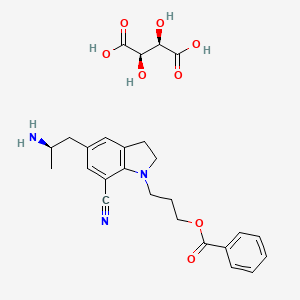
CAS · 239463-85-5
Product Overview
5-(2R)-2-Aminopropyl-1-3-(benzoyloxy)propyl-2,3-dihydro-1H-indole-7-carbonitrile (2R,3R)-2,3-dihydroxybutanedioate丨239463-85-5 appears to be a complex organic molecule, potentially related to pharmaceutical or biochemical applications.
Chemical Properties
Molecular Formula: The exact molecular formula depends on the combination of the core indole structure, benzoyloxy group, cyano (-CN) functionality, and tartaric acid (2,3-dihydroxybutanedioate) salt.
Structure: The core of the molecule consists of an indole system, which is often found in biologically active compounds. The presence of benzoyloxy (benzoate group) suggests a possible ester functionality, which could influence solubility and metabolic properties. The tartaric acid salt is commonly used to enhance the solubility or bioavailability of certain pharmaceutical compounds.
Product Specifications
| Property | Value |
|---|---|
| Appearance | Almost white powder or yellow powder |
| HPLC Purity | 99% min |
| Chiral Purity | 99% min |
| Identification | HPLC: The retention time is the same |
| Water | 1.0% max |
| Max. Individual Impurity | 0.5% max |
| Total Impurities | 1.0% max |
Applications
1.Pharmaceutical Industry
The indole core is a key structure found in many bioactive molecules, including neurotransmitters, alkaloids, and drugs.
The presence of a benzoyloxy group suggests lipophilicity, which may help in drug absorption and penetration through biological membranes.
The tartaric acid salt form suggests that this compound might be formulated for enhanced solubility and stability, which is often important in drug formulations.
2.Neuroscience and Psychiatry
Compounds with 2-aminopropylindole structures are sometimes related to research in neurotransmitters, such as serotonin or dopamine analogs.
The indole structure could indicate potential use in central nervous system-related drugs, possibly for psychiatric or neurological disorders.
3.Chemical Research
o5-(2R)-2-Aminopropyl-1-3-(benzoyloxy)propyl-2,3-dihydro-1H-indole-7-carbonitrile (2R,3R)-2,3-dihydroxybutanedioate丨239463-85-5 could be used in medicinal chemistry for developing new therapeutic agents.
The presence of a cyano (-CN) group could indicate involvement in enzyme inhibition or binding interactions with biological targets.
4.Chiral and Asymmetric Synthesis
The (2R,3R)-2,3-dihydroxybutanedioate (tartaric acid salt) suggests that the compound may be a chiral pharmaceutical agent.
Many drugs exist in stereochemically pure forms, and tartaric acid is often used to resolve enantiomers for biological activity optimization.
Benefits
The key benefits and differentiators of this product are available on request. Contact us for performance data, comparative specifications and selection guidance.
Conclusion
5-(2R)-2-Aminopropyl-1-3-(benzoyloxy)propyl-2,3-dihydro-1H-indole-7-carbonitrile (2R,3R)-2,3-dihydroxybutanedioate丨239463-85-5 likely belongs to the pharmaceutical or medicinal chemistry domain, potentially as a drug candidate or research chemical. The indole framework, combined with amino, benzoyloxy, and cyano groups, along with the tartaric acid salt, suggests applications in neurology, medicinal chemistry, or pharmacology. Further studies would be needed to confirm its exact therapeutic role and biological effects.
Previous
2,5-Dimethoxybenzaldehyde丨CAS 93-02-7
Next