
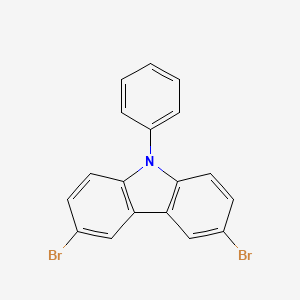
CAS · 57103-20-5
Product Overview
3,6-Dibromo-9-phenyl-9H-carbazole丨CAS 57103-20-5 is an organic compound known for its versatility as an intermediate in the development of advanced materials. Its primary use lies in organic synthesis, with significant applications in electronic and optoelectronic fields.
Product Specifications
| Property | Specification |
|---|---|
| Appearance | Yellow to light yellow liquid, with a characteristic borage seed aroma |
| Specific Gravity | 0.915~0.925 |
| Refractive Index | 1.471~1.488 |
| Unsaponifiable Matter | 0.05% max |
| Peroxide Value (meq/kg) | 3.0% max |
| Moisture and Volatiles | 0.05% max |
| Acid Value | 1.0 mg KOH/kg max |
| Free Fatty Acids | 0.10% max |
| Gamma-Linolenic Acid | 18% max |
| Linoleic Acid | 12.0~45% |
Applications
1. Organic Electronics and Optoelectronics:
- Semiconducting Materials: This compound is used to create conjugated polymers with excellent semiconducting properties. These materials are integral to technologies like organic light-emitting diodes (OLEDs), organic photovoltaics (OPVs), and organic field-effect transistors (OFETs).
- Photovoltaic Applications: As a precursor in the synthesis of photovoltaic materials, it aids in developing donor-acceptor polymers. These polymers enhance light absorption and charge transport, critical for solar cell efficiency.
2. Materials Science:
- Advanced Electronic Materials: 3,6-Dibromo-9-phenyl-9H-carbazole contributes to the creation of materials with specific electronic and optical characteristics. These materials are valued in devices requiring high charge mobility and stability.
- Photoconductive Devices: It plays a role in designing photoconductive materials for imaging systems, photodetectors, and other light-sensitive applications.
3. Polymer Chemistry:
- Polymer Synthesis: The compound serves as a monomer or co-monomer in producing specialty polymers. These polymers exhibit tailored electronic properties, making them suitable for a range of industrial applications.
- Optoelectronic Copolymers: Its use in the synthesis of copolymers ensures enhanced optical and electrical performance, beneficial for OLEDs and related technologies.
4. Molecular Electronics:
- Organic Thin-Film Transistors (OTFTs): The compound is utilized in OTFTs, enabling lightweight, flexible, and efficient electronic devices. These devices are prominent in wearable electronics and flexible display technologies.
Benefits
1. Versatile Building Block:
- Its bromine atoms provide reactive sites, allowing for diverse chemical modifications and the creation of specialized polymers and materials.
2. Enhanced Electronic Properties:
- Materials synthesized from this compound exhibit excellent charge mobility, vital for high-performance electronic devices.
3. Thermal and Chemical Stability:
- Devices incorporating materials derived from 3,6-Dibromo-9-phenyl-9H-carbazole benefit from its stability, ensuring durability and reliability under operational stress.
4. Tunable Optoelectronic Features:
- It enables the customization of material properties, such as bandgap and luminescence, to suit specific applications in optoelectronics.
5. Support for Emerging Technologies:
- Its inclusion in innovative designs makes it pivotal in advancing technologies like flexible electronics and next-generation solar cells.
Conclusion
A concise summary and suitability assessment for this product is available on request. Contact our team to discuss whether it fits your process and quality requirements.