
3-(Cyclohexylamino)-2-hydroxy-1-propanesulfonic acid
CAS 73463-39-5
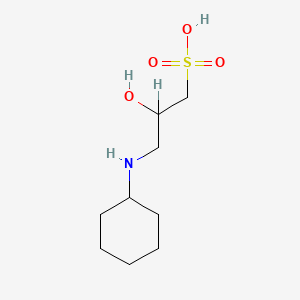
CAS · 73463-39-5
Product Overview
3-(Cyclohexylamino)-2-hydroxy-1-propanesulfonic acid is a high-purity water-treatments supplied for industrial and specialty chemical applications. Contact our team for specifications, packaging options and lead times.
Product Specifications
| Appearance: | White crystalline powder |
|---|---|
| Assay: | 99.0% - 101.0% |
| Water Content: | 0.5% max |
| Loss on drying: | 1% max |
| Melt point: | 270°C (decompose) max |
| Solubility (1.0 M aqueous): | Colorless to clarify |
| pH (1.0 M aqueous): | 5.0 ~ 6.5 |
| Heavy metal (Pb): | 0.0005% max |
| Ultraviolet absorbance / 260 nm: | 0.04 max |
| Ultraviolet absorbance / 280 nm: | 0.03 max |
Applications
1. Membrane Protein Research
3-(Cyclohexylamino)-2-hydroxy-1-propanesulfonic acid丨CAS 73463-39-5 is extensively used to solubilize membrane proteins for:
Structural studies (e.g., crystallography, NMR)
Functional assays
Protein purification
Maintains protein functionality by minimizing denaturation, unlike harsh ionic detergents.
2. Cell and Tissue Extraction
Facilitates extraction of proteins from biological membranes without disrupting protein-protein interactions.
Common in protocols for isolating integral membrane proteins, receptors, and enzymes.
3. Protein Folding and Stability Studies
Used to study protein folding dynamics in environments mimicking native membranes.
Helps maintain protein solubility and prevents aggregation.
4. Enzymology and Biochemical Assays
Suitable for enzyme activity assays requiring mild detergent conditions.
Preserves enzymatic activity by preventing denaturation.
5. Pharmaceutical and Biotech
Utilized in formulation of protein-based therapeutics where gentle solubilization is required.
Important in drug screening assays involving membrane proteins.
Benefits
Zwitterionic nature: Contains both positive and negative charges, reducing protein denaturation.
Mild detergent: Solubilizes lipids and proteins effectively without disrupting protein tertiary structure.
Water soluble: Highly soluble, easy to use in aqueous buffers.
Non-denaturing: Preserves biological activity of proteins.
Low UV absorbance: Compatible with spectroscopic techniques.
Critical micelle concentration (CMC): ~6-10 mM, useful for optimizing solubilization conditions.
Conclusion
A concise summary and suitability assessment for this product is available on request. Contact our team to discuss whether it fits your process and quality requirements.