
3-(2-(2-(2-Aminoethoxy)ethoxy)ethoxy)propanoic Acid
CAS 784105-33-5
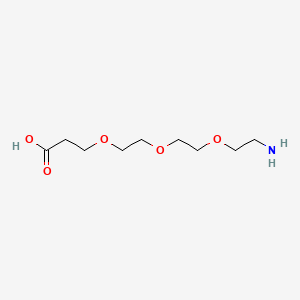
CAS · 784105-33-5
Product Overview
3-(2-(2-(2-Aminoethoxy)ethoxy)ethoxy)propanoic Acid is a high-purity polyethylene-glycol supplied for industrial and specialty chemical applications. Contact our team for specifications, packaging options and lead times.
Product Specifications
| Appearance: | White to off white solid |
|---|---|
| Assay (QNMR): | 95.0% min |
| ¹H NMR identification: | Conform to structure |
| Water content: | 2.0% max |
Applications
1. Bioconjugation and Drug Delivery
Linker in PEGylation: The compound's PEG-like backbone and terminal groups allow it to serve as a spacer or linker for attaching drugs to peptides, proteins, or nanoparticles.
Targeted drug carriers: Its amino and carboxyl groups provide conjugation points for coupling with targeting moieties or payloads in antibody-drug conjugates (ADCs) and nanocarriers.
2. Polymer and Surface Modification
Hydrophilic surface coatings: Often used in modifying surfaces (glass, metal, polymers) to improve water compatibility or reduce protein adsorption.
Reactive polymer building block: Useful in synthesizing water-soluble polymers or hydrogels via condensation, amidation, or Michael addition reactions.
3. Biomedical Research
Crosslinking agent: Facilitates the creation of biocompatible hydrogels by reacting with NHS-esters, isocyanates, or epoxy-functional compounds.
Tether for biosensors: In immobilization of biomolecules on sensor surfaces for bioassays or diagnostics (e.g., ELISA, SPR, QCM).
4. Nanotechnology
Functionalizing nanoparticles: Used to impart biocompatibility and introduce reactive sites onto gold, silica, or polymer nanoparticles.
Spacer in dendrimer and micelle synthesis: Facilitates design of well-defined molecular architectures with hydrophilic and functional outer layers.
Benefits
1. Dual Reactivity
The molecule contains both an amine and a carboxylic acid group, enabling it to act as a bridge or tether between various classes of molecules in bioconjugation and surface modification applications.
2. PEG-like Hydrophilicity
The triethylene glycol chain provides excellent water solubility and reduces nonspecific binding, making it ideal for biomedical and pharmaceutical systems.
3. Biocompatibility
Similar to PEG derivatives, it is non-toxic, minimally immunogenic, and safe for biological applications, especially for in vivo use.
4. Flexible Molecular Engineering
The flexible ether chain offers conformational freedom, aiding in maintaining bioactivity of conjugated molecules or avoiding steric hindrance in surface-bound systems.
5. Compatibility with Standard Coupling Chemistries
Can be used with:
EDC/NHS coupling for amide bond formation
Click chemistry (when appropriately functionalized)
Carbodiimide-based activation for conjugation to proteins or peptides
Conclusion
3-(2-(2-(2-Aminoethoxy)ethoxy)ethoxy)propanoic acid (CAS 784105-33-5) is a versatile and highly functional compound widely used in bioconjugation, polymer chemistry, and nanotechnology. Its combination of hydrophilicity, biocompatibility, and dual-reactive groups allows for efficient linkage between organic, biological, and inorganic components in both research and industrial applications.
Previous
[2-[2-(Fmoc-amino)ethoxy]ethoxy]acetic Acid丨CAS 166108-71-0
Next