
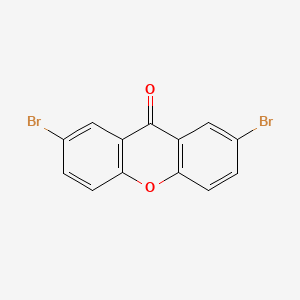
CAS · 40102-85-0
Product Overview
2,7-dibromo-9H-xanthen-9-one is a high-purity pharmaceutical-intermediates supplied for industrial and specialty chemical applications. Contact our team for specifications, packaging options and lead times.
Product Specifications
| Appearance | Off-white or white solid |
|---|---|
| Purity | 98% min |
Applications
2,7-Dibromo-9H-xanthen-9-one (CAS 40102-85-0) is a brominated xanthone derivative widely used in organic synthesis, dye chemistry, and materials science. It serves as a key intermediate for the preparation of fluorescent dyes, photosensitizers, and laser dyes, where the xanthone core provides strong photophysical properties. In chemical research, it is used for the synthesis of functionalized xanthone derivatives via cross-coupling reactions, such as Suzuki or Heck reactions, allowing the introduction of diverse substituents at the bromine positions. It also finds application in the development of organic semiconductors, photocatalysts, and imaging probes for biomedical and analytical studies due to its stable aromatic structure and tunable electronic properties.
Benefits
The benefits of 2,7-dibromo-9H-xanthen-9-one are derived from its dual bromine functionality, rigid xanthone scaffold, and photostability. The bromine atoms act as reactive handles for selective substitution or coupling reactions, enabling the construction of a wide variety of derivatives for dyes, materials, and bioactive probes. Its aromatic xanthone core provides high thermal and photochemical stability, which is essential for fluorescent and optoelectronic applications. Additionally, the compound's tunable electronic properties allow researchers to design molecules with optimized absorption, emission, and charge-transfer characteristics, enhancing performance in imaging, sensing, and material applications.
Conclusion
In summary, 2,7-dibromo-9H-xanthen-9-one is a versatile intermediate used in dye synthesis, material development, and chemical research. Its applications include fluorescent dyes, photocatalysts, and functionalized xanthone derivatives, while its benefits lie in reactive bromine positions, structural stability, and tunable electronic and photophysical properties. As demand for high-performance dyes and functional materials grows, this compound remains a critical tool for innovation in both chemical and materials science.
Previous
Triethylamine Hydrochloride丨CAS 554-68-7
Next