
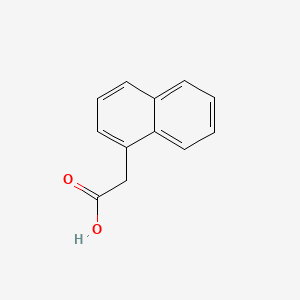
CAS · 86-87-3
Product Overview
1-Naphthalene acetic acid丨86-87-3 is a synthetic plant growth regulator belonging to the auxin class of plant hormones. It is structurally similar to indole-3-acetic acid (IAA), a naturally occurring auxin. NAA is widely used in agriculture and horticulture due to its ability to regulate plant growth, promote root development, and induce fruit ripening. It is also used in laboratory research for plant physiology studies.
Product Specifications
| Property | Specification |
|---|---|
| Appearance | Off-white powder |
| Assay | 98% min |
| Melting Point | 130.0 to 132.0°C |
| Residue on Ignition | 0.5% max |
| Loss on Drying | 0.5% max |
Applications
1. Agricultural and Horticultural Uses
● Root Induction in Plant Cuttings:
o1-Naphthalene acetic acid丨86-87-3 is commonly used to stimulate root formation in plant cuttings, enhancing vegetative propagation for a wide range of plants, including trees, shrubs, and ornamental species.
● Fruit Ripening and Development:
It is applied to promote fruit development, particularly in grapes, apples, and tomatoes, as it helps induce uniform ripening and prevents premature drop.
● Control of Fruit Set:
NAA is sometimes used to manipulate the fruit set in crops like citrus and apples, either to enhance or reduce fruit production as needed.
● Vegetative Growth Regulation:
Used to regulate the growth of plants, NAA can promote lateral branching and compact growth in certain crops, such as ornamentals and vegetables.
2. Agricultural Biotechnology
● Crop Yield Enhancement:
In agricultural biotechnology, 1-Naphthalene acetic acid丨86-87-3 is used in biotechnological applications such as tissue culture and genetic engineering to promote cell division and growth.
● Micropropagation:
NAA is employed in micropropagation techniques for the rapid production of genetically identical plants through in vitro cultivation. It aids in the establishment of healthy root systems in tissue-cultured plants.
3. Laboratory and Research Applications
● Plant Growth Studies:
NAA is frequently used in plant growth and physiology research to study the effects of auxins on cell elongation, rooting behavior, and plant development.
● Regulation of Plant Hormone Pathways:
It is used in experimental research to investigate how different auxins and their synthetic analogs affect plant growth, signal transduction, and developmental processes.
4. Use in Forestry and Landscaping
● Rooting of Woody Plants:
In forestry and landscaping, NAA is applied to propagate woody plants, such as conifers and hardwood trees, by stimulating root formation in cuttings.
● Tree Nursery Applications:
It is used in nurseries to enhance root growth and improve the survival rate of transplanted saplings.
Benefits
1. Promotes Root Formation and Plant Propagation
● NAA is highly effective in inducing root formation in plant cuttings, making it an essential tool for vegetative propagation and clonal propagation in horticulture and agriculture.
2. Enhances Fruit Set and Ripening
● It plays a key role in improving fruit yield, especially in crops like grapes, apples, and tomatoes, by promoting uniform ripening and reducing the premature shedding of fruits.
3. Increases Agricultural Productivity
● NAA contributes to higher crop yields by regulating the growth of plants, improving the root system and overall plant development, leading to healthier, more productive plants.
4. Facilitates Micropropagation and Biotechnology
● Used in tissue culture and micropropagation, NAA is critical for scaling up the production of genetically uniform plants, enhancing crop production for research, agriculture, and horticulture.
5. Cost-Effective and Easy to Use
● NAA is relatively inexpensive, easy to apply, and highly effective in its role as a plant growth regulator, making it a popular choice for use in agriculture, horticulture, and research.
Conclusion
1-Naphthalene acetic acid丨86-87-3 is a versatile and powerful plant growth regulator with a wide range of applications in agriculture, horticulture, and biotechnology. Its ability to promote root formation, regulate fruit development, and enhance plant propagation makes it an invaluable tool in modern agriculture. Additionally, NAA's role in biotechnological research and plant growth studies continues to drive advances in the understanding of plant biology and the development of new agricultural practices.
Previous
Chlorosulfonyl Isocyanate丨CAS 1189-71-5
Next