
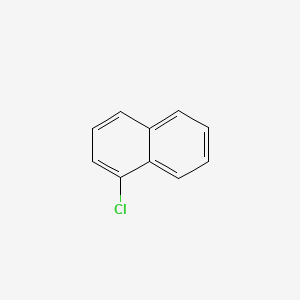
CAS · 90-13-1
Product Overview
1-Chloronaphthalene is a high-purity dyes-pigments supplied for industrial and specialty chemical applications. Contact our team for specifications, packaging options and lead times.
Product Specifications
| Appearance | Clear to light yellow liquid |
|---|---|
| Assay | a-Form: 85 to 91%, β-Form: 8 to 13% |
| Iron (Fe) | 1.5 ppm max |
| Water | 0.1% max |
Applications
1. Dielectric and Insulating Fluids
Historically used in capacitors and transformers due to its high dielectric constant and chemical stability.
However, modern applications have largely shifted away due to environmental and toxicity concerns.
2. Solvent for Specialty Applications
Effective solvent for resins, greases, and waxes, especially in analytical chemistry and materials testing.
Used in refractive index matching due to its high refractive index (~1.63), helpful in microscopy and optical studies.
3. Intermediate in Organic Synthesis
Serves as a starting material for synthesizing various aromatic compounds, including:
Dyes
Agrochemicals
Pharmaceuticals
Useful in chlorinated aromatic compound research and halogen exchange reactions.
4. Research and Development
Employed in laboratories for polyaromatic compound studies.
Acts as a model compound in studies related to chlorinated hydrocarbons and environmental persistence.
Benefits
✅ High Chemical Stability: Resistant to heat and oxidation, making it suitable for some high-temperature applications.
✅ Good Solvency Power: Dissolves a variety of hydrophobic substances.
✅ Optical Uses: High refractive index makes it useful in microscopy and optics, particularly for RI matching in crystal and fiber studies.
✅ Synthetic Utility: Valuable precursor for more complex halogenated naphthalene derivatives.
Conclusion
1-Chloronaphthalene (CAS 90-13-1) is a halogenated aromatic compound historically valued for its use as a dielectric fluid, solvent, and intermediate in chemical synthesis. While its applications have declined due to environmental and health concerns, it remains relevant in certain niche industrial processes, academic research, and specialty chemical manufacturing. Its high chemical stability and strong solvency still offer advantages in controlled laboratory and industrial settings where its specific properties are required.
Previous
Next