
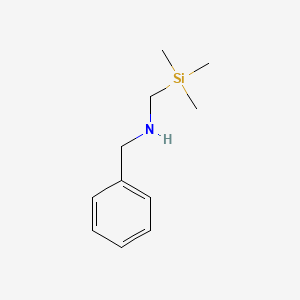
CAS · 53215-95-5
Product Overview
N-(Trimethylsilyl)methylbenzylamine is a high-purity surfactants supplied for industrial and specialty chemical applications. Contact our team for specifications, packaging options and lead times.
Product Specifications
| Appearance | Colorless to light yellow liquid |
|---|---|
| Purity (NMR) | 98.0% min. |
| 1H NMR Spectrum | Conforms |
| Water | 1.0% max. |
Applications
N-(Trimethylsilyl)methylbenzylamine is an organosilicon compound that finds applications in synthetic organic chemistry as a useful reagent and intermediate. Its structure, combining a benzylamine moiety with a trimethylsilyl substituent, provides enhanced reactivity and selectivity in transformations involving nucleophilic substitution, reductive amination, and protective group strategies. It is often used in the preparation of heterocycles, pharmaceuticals, and fine chemicals, where the trimethylsilyl group can act as a temporary stabilizing or directing functionality. Additionally, the compound's properties make it suitable for organometallic chemistry applications, including as a ligand precursor or reagent in transition-metal-catalyzed reactions.
Benefits
The benefits of N-(trimethylsilyl)methylbenzylamine are rooted in its stability, versatility, and adaptability in synthetic pathways. The trimethylsilyl group enhances the solubility of intermediates in organic solvents, facilitates selective transformations, and can be removed under mild conditions without affecting other sensitive groups. Its ability to serve as both a protective and reactive handle allows chemists to streamline multistep syntheses, improving efficiency and reducing unwanted side reactions. Furthermore, its compatibility with a wide range of catalytic systems broadens its scope in advanced chemical synthesis, making it a valuable tool in the preparation of complex molecular architectures.
Conclusion
N-(Trimethylsilyl)methylbenzylamine (CAS 53215-95-5) is a practical and multifunctional compound in modern organic synthesis, particularly valued for its role as a versatile intermediate and protective group reagent. By combining the chemical reactivity of benzylamine with the stabilizing features of a trimethylsilyl substituent, it provides unique advantages in both efficiency and selectivity. Its broad utility across pharmaceutical, fine chemical, and catalytic research ensures its continued importance in advanced synthetic methodologies.
Previous
Decanoyl- And Octanoyl Glycerides丨CAS 73398-61-5
Next