
1-(2-chloro-4-hydroxyphenyl)-3-cyclopropylurea
CAS 796848-79-8
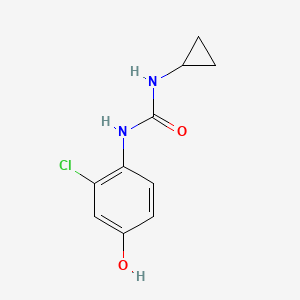
CAS · 796848-79-8
Product Overview
1-(2-chloro-4-hydroxyphenyl)-3-cyclopropylurea is a high-purity pharmaceutical-intermediates supplied for industrial and specialty chemical applications. Contact our team for specifications, packaging options and lead times.
Product Specifications
| Appearance: | Off-white to brownish pink color powder |
|---|---|
| Identification: | HPLC: The retention time of the major peak of the sample solution corresponds to that of the reference solution, as obtained in the Assay |
| Solubility: | Soluble in DMF |
| Loss on drying: | ≤0.5% |
| Residue on ignition: | ≤0.3% |
| Related substances - LV-4: | ≤0.2% |
| Related substances - Any other individual impurity: | ≤0.5% |
| Related substances - Total impurities: | ≤1.0% |
| Purity: | 99% min |
Applications
1-(2-Chloro-4-hydroxyphenyl)-3-cyclopropylurea is a versatile intermediate predominantly used in pharmaceutical and agrochemical synthesis. Its urea functional group, coupled with a chloro- and hydroxy-substituted phenyl ring, provides a reactive framework for the development of biologically active molecules. In medicinal chemistry, it is employed in the synthesis of kinase inhibitors, enzyme modulators, and other small-molecule therapeutics targeting cancer, inflammatory diseases, and metabolic disorders. The cyclopropyl moiety contributes steric rigidity and influences the conformational profile of downstream molecules, which can enhance receptor binding affinity and selectivity. Additionally, this compound is used in agrochemical research for the preparation of herbicides, fungicides, and insecticides, where the urea scaffold is known for its efficacy in controlling plant growth and pests. Its structural features also allow chemists to explore structure–activity relationships (SAR) and optimize bioactive compounds in both pharmaceutical and agricultural applications.
Benefits
The benefits of 1-(2-Chloro-4-hydroxyphenyl)-3-cyclopropylurea stem from its chemical reactivity, stability, and structural versatility. The phenolic hydroxyl group allows for selective derivatization or hydrogen-bonding interactions, while the chloro substituent enhances chemical stability and lipophilicity in target molecules. The cyclopropyl ring introduces conformational rigidity that often improves metabolic stability and receptor binding efficiency. Its urea functionality serves as a key site for forming hydrogen bonds, which can enhance molecular recognition in drug or agrochemical targets. Moreover, the compound's stability under standard reaction conditions and compatibility with diverse chemical transformations make it an efficient intermediate for high-yield synthesis and reproducible chemical processes.
Conclusion
1-(2-Chloro-4-hydroxyphenyl)-3-cyclopropylurea is a high-value intermediate that supports innovation in pharmaceutical and agrochemical development. Its combination of functional versatility, chemical stability, and structural features enables the efficient creation of potent and selective bioactive molecules. By facilitating precise molecular modification and optimizing downstream compound properties, this intermediate continues to be a critical building block in modern drug discovery and agricultural chemistry.
Previous
Thiomorpholine-1,1-dioxide Hydrochloride丨CAS 59801-62-6
Next
6-Fluoro-3-(4-piperidinyl)-1,2-benzisoxazole Hydrochloride丨CAS 84163-13-3