
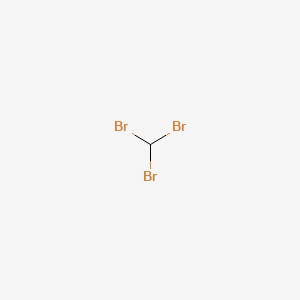
CAS · 75-25-2
Product Overview
Bromoform is a high-purity solvents supplied for industrial and specialty chemical applications. Contact our team for specifications, packaging options and lead times.
Product Specifications
| Appearance: | Colorless transparent liquid |
|---|---|
| Assay: | 99% min |
| Water: | 500 ppm max |
| Non-volatile: | 500 ppm max |
| pH: | 6.0–8.0 |
| Stabilizer (anhydrous ethanol): | 1%–3% |
Applications
1. Laboratory Reagent
Bromoform丨CAS 75-25-2 is commonly used as a solvent or reagent in organic synthesis, especially in halogenation reactions and the formation of carbenes for cyclopropanation or rearrangement reactions. It also plays a role in the synthesis of pharmaceutical intermediates.
2. Density Separation
Due to its high density (~2.89 g/cm³), bromoform is used in mineralogy and geology for the separation of minerals and fossil materials from less dense rock matrices via heavy liquid separation.
3. Marine and Environmental Research
Bromoform is produced biologically by phytoplankton and algae, and it plays a role in atmospheric chemistry by contributing to the halogen cycle. It is studied in climate science due to its role in ozone depletion in the lower stratosphere.
4. Anesthetic and Antiseptic History
Historically, bromoform was used as a sedative and antiseptic, although these applications are now obsolete due to toxicity concerns. However, it remains a subject of toxicological and pharmacological research.
5. Intermediate in Chemical Manufacturing
Bromoform is used in the production of other brominated organic compounds, and in specialty chemical synthesis, including flame retardants and fine chemicals.
Benefits
✅ Useful in Specialized Separation Processes
Its high density makes it highly effective for precise gravity-based separations in geological and materials sciences.
✅ Reagent in Synthetic Organic Chemistry
Bromoform is a valuable halogenated intermediate for the synthesis of more complex compounds in chemical research.
✅ Natural Product Studies
Its presence in the ocean and role in halogen cycling makes it a key compound in environmental monitoring and marine biosynthesis research.
Previous
Isopropyl Nitrate丨CAS 1712-64-7
Next
1,3-Dimethyl-3,4,5,6-tetrahydro-2(1H)-pyrimidinone丨CAS 7226-23-5
Conclusion
A concise summary and suitability assessment for this product is available on request. Contact our team to discuss whether it fits your process and quality requirements.