
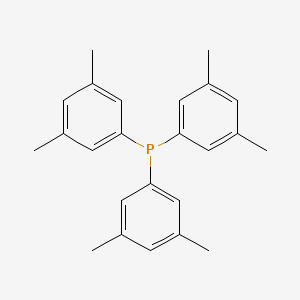
CAS · 69227-47-0
Product Overview
Tris(3,5-dimethylphenyl)phosphine is a high-purity organophosphorus-compounds supplied for industrial and specialty chemical applications. Contact our team for specifications, packaging options and lead times.
Product Specifications
| Appearance | White powder |
|---|---|
| Purity | 98.0% min |
| Insolubles (in DCM solvent) | 1% max |
| Identification | HNMR conforms |
Applications
Tris(3,5-dimethylphenyl)phosphine is an organophosphorus compound widely used as a ligand in homogeneous catalysis and organometallic chemistry. It serves as a bulky, electron-rich phosphine ligand in transition-metal-catalyzed reactions, including cross-coupling, hydrogenation, and hydroformylation processes. Its sterically demanding structure stabilizes metal centers, improving catalyst activity, selectivity, and longevity. In fine chemical and pharmaceutical synthesis, it is employed to enhance reaction efficiency, control stereochemistry, and facilitate the production of complex organic molecules. Additionally, it is used in the preparation of specialized phosphine-metal complexes and functionalized organophosphorus compounds for advanced material applications and research purposes.
Benefits
The benefits of Tris(3,5-dimethylphenyl)phosphine derive from its combination of steric bulk and electron-rich characteristics. The 3,5-dimethylphenyl groups provide significant steric hindrance, which helps prevent undesired side reactions and stabilizes metal-ligand complexes. Its electron-donating properties enhance the electron density at the metal center, improving catalytic activity and efficiency. The ligand's stability, solubility in organic solvents, and compatibility with a wide range of metals make it versatile for laboratory and industrial-scale synthesis. Its use results in higher yields, improved selectivity, and more efficient catalytic processes in both pharmaceutical and fine chemical production.
Conclusion
Tris(3,5-dimethylphenyl)phosphine is a versatile phosphine ligand widely used in homogeneous catalysis, organometallic chemistry, and fine chemical synthesis. Its steric bulk and electron-rich nature provide enhanced catalyst stability, reactivity, and selectivity, enabling efficient production of complex molecules. The benefits it offers-including improved reaction efficiency, control over stereochemistry, and compatibility with various metals-make it a valuable reagent for research and industrial applications in pharmaceuticals, advanced materials, and high-performance chemical synthesis.
Previous
Tri-tert-butylphosphine Tetrafluoroborate丨CAS 131274-22-1
Next
(S)-(-)-2,2-Bis(diphenylphosphino)-1,1-binaphthyl丨CAS 76189-56-5