
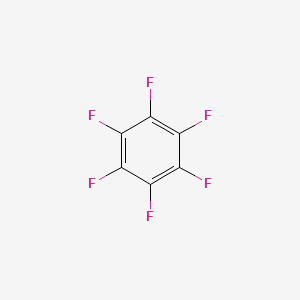
CAS · 392-56-3
Product Overview
Perfluorobenzene丨392-56-3 is a fluorinated aromatic compound in which all hydrogen atoms in benzene are replaced by fluorine. It is a chemically stable, non-reactive, and hydrophobic solvent with applications in organic synthesis, electronics, and material science.
Product Specifications
| Property | Specification |
|---|---|
| Appearance | Colorless transparent liquid |
| Purity (GC) | 99.0% min |
| Water | 0.1% max |
| Boiling Point | 80-81℃ |
| Density | 1.60-1.62 g/cm³ |
Applications
1. Chemical and Pharmaceutical Synthesis
Fluorinating Reagent:
Used as a precursor in the synthesis of fluorinated organic compounds.
Solvent for Organometallic Reactions:
Acts as a non-polar, chemically inert solvent in specialized organic reactions.
2. Electronics and Material Science
Semiconductor Industry:
Used in electronic materials and coatings due to its thermal and chemical stability.
Liquid Crystals and Polymers:
Applied in the development of advanced materials, including liquid crystal displays (LCDs) and high-performance polymers.
3. NMR Spectroscopy
Deuterated Solvent Alternative:
Used as a non-interfering solvent in nuclear magnetic resonance (NMR) spectroscopy for fluorine-related studies.
4. Aerospace and Coating Applications
Protective Coatings:
Used in the development of fluoropolymer coatings for corrosion and heat resistance.
Benefits
1. High Chemical and Thermal Stability
● Resistant to oxidation, acids, and bases, making it useful in harsh chemical environments.
2. Excellent Solvent for Fluorinated Compounds
● Ideal for fluorine-containing organic reactions and material synthesis.
3. Low Reactivity and Non-Toxicity
● Exhibits low reactivity with other chemicals, ensuring safe handling in industrial applications.
4. Hydrophobic and Nonpolar Nature
● Provides unique solubility properties, making it valuable in specialized chemical processes.
Conclusion
Perfluorobenzene丨392-56-3 is a versatile fluorinated compound with applications in organic synthesis, electronics, NMR spectroscopy, and material science. Its chemical inertness, thermal stability, and hydrophobic properties make it a valuable solvent and precursor in advanced industrial and scientific fields.
Previous
Next