
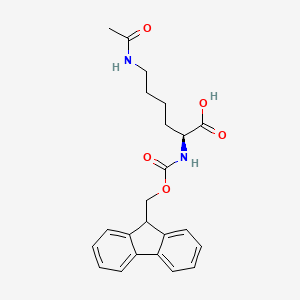
CAS · 159766-56-0
Product Overview
Fmoc-N-Acetyl-L-lysine is a high-purity biochemical-reagents supplied for industrial and specialty chemical applications. Contact our team for specifications, packaging options and lead times.
Product Specifications
| Appearance: | White to off-white powder |
|---|---|
| Purity (HPLC): | 98% min |
| TLC: | 98% min |
| Melting Point: | 155°C to 165°C |
| Specific Rotation [α]20D: | -13.5° ± 2° (C=1 in DMF) |
| Clarity of solution: | 0.3 g in 2 mL DMF clear solution |
| Element analysis (C, H, N): | 5% max |
| Water: | 1% max |
| Loss on drying: | 1% max |
| IR Spectrum: | In accordance with the structure |
| Mass Spectrum: | In accordance with the structure |
| NMR Spectrum: | In accordance with the structure |
Applications
Fmoc-N-Acetyl-L-lysine is a protected amino acid derivative widely used in peptide synthesis, medicinal chemistry, and biochemical research. The Fmoc (9-fluorenylmethoxycarbonyl) group protects the amino terminus, while the N-acetyl modification blocks lysine's side-chain amine, allowing selective reactions on other positions during solid-phase or solution-phase peptide synthesis. It serves as a key building block for synthesizing modified peptides, peptidomimetics, and protein analogs, including those used in enzyme studies, receptor binding assays, and structural biology investigations. This compound is also employed in epigenetic research as a mimic of acetylated lysine residues, which are critical in studying histone modifications, protein–protein interactions, and gene regulation mechanisms. Additionally, it is used in the development of novel therapeutics and chemical probes targeting post-translational modifications.
Benefits
The benefits of Fmoc-N-Acetyl-L-lysine arise from its chemical stability, selective protection, and versatility in peptide chemistry. The Fmoc group is base-labile, allowing easy removal under mild conditions without affecting other protecting groups, while the N-acetyl modification prevents unwanted side reactions on the lysine side chain. Its use ensures high yield and fidelity in peptide synthesis and reduces by-product formation. The compound's well-defined stereochemistry maintains the biological activity and conformational integrity of peptides, which is critical for structure–function studies. Its compatibility with standard coupling reagents and resins facilitates incorporation into both standard and modified peptide sequences. Moreover, its role as a mimic of acetylated lysine residues provides researchers with a reliable tool for studying protein function, epigenetic mechanisms, and enzyme interactions.
Conclusion
Fmoc-N-Acetyl-L-lysine (CAS 159766-56-0) is an essential protected amino acid for peptide synthesis and biochemical research. Its dual protection strategy enables selective, high-fidelity peptide assembly and modification, while its structural mimicry of acetylated lysine supports studies in epigenetics and protein function. By combining chemical stability, synthetic versatility, and biological relevance, this compound is a valuable tool in modern peptide chemistry, medicinal chemistry, and molecular biology research.
Previous
Serratiopeptidase丨CAS 37312-62-2
Next