CAS · 3946-32-5
Product Overview
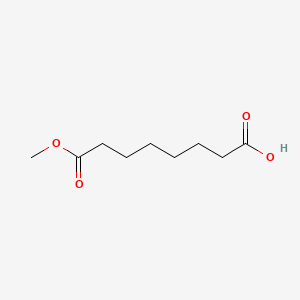
Suberic acid monomethyl ester is a high-purity daily-chemicals supplied for industrial and specialty chemical applications. Contact our team for specifications, packaging options and lead times.
Product Specifications
| Appearance: | Light yellow liquid or solid |
|---|---|
| Purity: | 95% min |
Applications
1. Pharmaceutical and Medicinal Chemistry
● Intermediate in Drug Synthesis: This compound is used as a building block in the synthesis of various bioactive molecules, particularly those involving linker regions or flexible aliphatic chains.
● Prodrug Design: Its functional groups (one free acid, one ester) are ideal for incorporation into prodrugs, allowing for controlled hydrolysis and release of the active pharmaceutical ingredient (API) within the body.
● Peptidomimetics and Bioconjugates: The bifunctional nature of this molecule makes it suitable for use in peptide conjugation, helping create flexible spacers or linkers between bioactive entities like peptides, small molecules, or antibodies.
2. Polymer and Material Science
● Precursor for Polyesters and Polyamides: Suberic acid monomethyl ester can be polymerized or co-polymerized with diols or diamines to produce aliphatic polyesters or polyamides, which are used in biodegradable plastics and medical implants.
● Spacer in Crosslinking Agents: Its structure makes it ideal for use as a spacer or chain extender in polymers, helping to modulate flexibility, solubility, and mechanical strength.
3. Chemical Synthesis and Derivatization
● Versatile Intermediate: It is often used as a synthon in organic synthesis, especially when stepwise functionalization is needed. The free acid and ester allow for orthogonal chemistry-that is, selective reactions at one functional group without disturbing the other.
● Macrocyclic Compounds: The flexible 8-carbon chain of suberic acid derivatives is frequently used to synthesize macrocyclic molecules such as crown ethers or host–guest systems in supramolecular chemistry.
4. Surface Modification and Bioconjugation
● Surface Functionalization: In materials science and nanotechnology, Suberic acid monomethyl ester丨CAS 3946-32-5 is employed in surface coating or anchoring strategies, where its carboxylic acid or ester groups can be used to covalently attach molecules to surfaces such as nanoparticles or polymers.
● Bioconjugation Linker: In biotechnology, this compound serves as a crosslinker or spacer for bioconjugates, such as attaching fluorophores or drugs to biomolecules (proteins, antibodies).
Benefits
1. Dual Functional Groups for Versatile Chemistry
● The presence of both a carboxylic acid and an ester group allows for selective functionalization. This enables chemists to carry out stepwise transformations, which is especially valuable in complex synthetic routes or multistep reactions.
2. Ideal Chain Length for Linker Applications
● With an 8-carbon backbone, it provides optimal flexibility and spacing between reactive groups, making it useful in molecular engineering, especially in drug conjugation and crosslinking applications.
3. Suitable for Biocompatible and Biodegradable Materials
● When incorporated into polymer backbones, it contributes to biodegradability and biocompatibility, which are essential traits for medical implants, tissue engineering, and controlled drug delivery systems.
4. High Purity and Customizability
● Suberic acid monomethyl ester is available in high-purity forms, which ensures reproducibility in synthetic and research applications. Its structure can also be custom-tailored via chemical modification to suit specific project needs.
Conclusion
Suberic acid monomethyl ester丨CAS 3946-32-5 is a valuable intermediate in a wide range of applications-from pharmaceutical synthesis to advanced materials development. Its bifunctional structure, chemical flexibility, and moderate hydrophobic chain make it ideal for use in polymer science, drug design, and bioconjugation chemistry. Its versatility, combined with its relative ease of handling and low toxicity, ensures that it remains a useful tool in both academic research and industrial innovation.
Previous
Myristyl Myristate丨CAS 3234-85-3
Next
Conclusion
A concise summary and suitability assessment for this product is available on request. Contact our team to discuss whether it fits your process and quality requirements.