
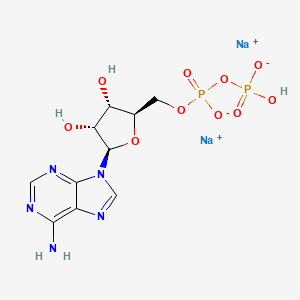
CAS · 16178-48-6
Product Overview
Adenosine-5-diphosphate disodium salt is a high-purity nucleosides-nucleotides supplied for industrial and specialty chemical applications. Contact our team for specifications, packaging options and lead times.
Product Specifications
| Appearance: | White to off-white crystal powder |
|---|---|
| Assay (on dried basis): | 90.0% min |
| Purity (HPLC): | 95% min |
| Identification: | The Max. absorption at 256nm ±2nm A250/A260 = 0.79~0.89 A280/A260 = 0.17~0.27 Dissolves in dilute nitric acid, add ammonium molybdate Ts, heat for a few minutes and cool, a yellow precipitate is produced Yields the flame reaction characteristic of sodium salts |
| pH: | 2.5 - 5.0 |
| Clarity and color of solution: | Clear and colorless |
| Protein: | Should comply with the standard |
| Loss on drying: | 10.0% max |
Applications
1. Biochemical and Molecular Biology Research
● Energy Metabolism Studies: Adenosine-5-diphosphate disodium salt丨CAS 16178-48-6 is an essential intermediate in studies of cellular respiration and photosynthesis. It helps researchers understand the conversion of ADP to ATP in oxidative phosphorylation and glycolysis.
● Enzymology: Used as a substrate or product in assays of kinases, phosphatases, and other enzymes that catalyze phosphoryl group transfer reactions. It is especially important in ATPase and ADPase activity assays.
● Signal Transduction Research: ADP plays a role in purinergic signaling (P2Y receptors), and it is often used in studies on cell signaling pathways, especially in platelet activation and vascular biology.
2. Pharmaceutical and Medical Research
● Platelet Aggregation Studies: ADP is used in in vitro assays to induce platelet aggregation-a critical process in blood clotting. This makes it useful for testing the efficacy of antiplatelet drugs like clopidogrel, ticlopidine, and prasugrel.
● Antithrombotic Drug Screening: As ADP plays a central role in platelet function, it is used in drug development targeting ADP receptors (like P2Y₁₂) to manage conditions such as thrombosis, stroke, and myocardial infarction.
● Diagnostics: In clinical laboratory diagnostics, ADP is a key component in coagulation panels to measure platelet function and evaluate patients on antiplatelet therapy.
3. Biomanufacturing and Cell Culture
● ATP Regeneration Systems: In bioprocessing and enzyme-catalyzed reactions, ADP is often a byproduct of ATP-dependent processes. Reagents or systems are used to reconvert ADP to ATP, improving process efficiency. It is monitored or supplemented depending on the system requirements.
● Metabolic Engineering: In genetically engineered cells, especially microbial cell factories, ADP levels are monitored to optimize metabolic flux and increase product yield (e.g., in biofuel, pharmaceutical, or biochemical production).
4. Educational and Demonstration Uses
● Teaching Laboratories: ADP is widely used in biochemistry and molecular biology classes to demonstrate energy transfer, enzyme reactions, and metabolic control, especially in relation to ATP/ADP cycling.
Benefits
1. High Water Solubility and Stability
● As a sodium salt, Adenosine-5-diphosphate disodium salt丨CAS 16178-48-6 is highly water-soluble, making it easy to prepare in aqueous buffers for biochemical assays or cell culture studies. It is also relatively stable under controlled conditions (pH ~7, refrigerated).
2. Biologically Relevant and Versatile
● ADP is naturally present in all living cells, making it biocompatible and non-toxic at physiological concentrations. This enables its use in both in vitro and in vivo studies without the risk of adverse effects.
3. Critical Role in Energy and Enzyme Dynamics
● Being at the heart of cellular energy metabolism, ADP is essential for understanding how energy flows through biological systems. It serves as a dynamic regulator, influencing the activity of enzymes, transporters, and metabolic pathways.
4. Support for Drug Development
● ADP is pivotal in the screening and development of therapeutics for cardiovascular diseases, particularly those involving platelet aggregation and thrombus formation. It supports discovery efforts for P2Y receptor antagonists and other related targets.
Conclusion
Adenosine-5-diphosphate disodium salt丨CAS 16178-48-6 is a central compound in cellular bioenergetics and signal transduction, with wide-ranging applications in biochemical research, medical diagnostics, and pharmaceutical development. Its high water solubility, biological relevance, and dual role as both a metabolic intermediate and receptor agonist make it a valuable tool in modern science. Whether used to study ATP synthesis, test platelet function, or develop cardiovascular drugs, ADP sodium salt remains a fundamental molecule in life science and biomedical research.
Previous
Azukisaponin VI丨CAS 82801-39-6
Next
Conclusion
A concise summary and suitability assessment for this product is available on request. Contact our team to discuss whether it fits your process and quality requirements.