
5-O-(4,4-Dimethoxytrityl)-N6-benzoyl-2-deoxyadenosine-3-(2-cyanoethyl-
CAS 98796-53-3
CAS · 98796-53-3
Product Overview
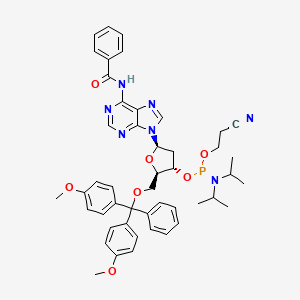
5-O-(4,4-Dimethoxytrityl)-N6-benzoyl-2-deoxyadenosine-3-(2-cyanoethyl-N,N-diisopropyl)phosphoramidite丨CAS 98796-53-3 is a protected nucleoside phosphoramidite derivative of 2'-deoxyadenosine. It features:
A 4,4-dimethoxytrityl (DMTr) group protecting the 5'-hydroxyl group,
An N6-benzoyl protecting group on the adenine base,
A 2-cyanoethyl-N,N-diisopropyl phosphoramidite group attached to the 3'-hydroxyl.
Such modifications make it a key intermediate for solid-phase DNA synthesis.
Product Specifications
| Appearance: | white to off-white powder |
|---|---|
| Solubility: | 0.2M solution in acetonitrile is free from undissolved particulate |
| Identity (by HNMR): | To conform structure |
| HPLC purity: | 99% min |
| Any single impurity: | 0.5% max |
| PNMR: | 98% min |
| P(Ш) Impurities (100-170ppm): | 0.5% max |
| Residual Solvent: | 3.0% max |
| Moisture: | 0.5% max |
Applications
1. Oligonucleotide Synthesis
This compound is a building block used in the automated chemical synthesis of DNA strands via the phosphoramidite method.
The DMTr group acts as a temporary protecting group for the 5'-OH to prevent unwanted reactions.
The N6-benzoyl group protects the exocyclic amine on adenine, preventing side reactions during chain assembly.
The 2-cyanoethyl phosphoramidite moiety is the reactive species that couples to the growing DNA chain in the synthesis cycle.
Following incorporation, the protecting groups are removed to yield natural DNA.
2. Research and Diagnostic Tools
Used for preparing custom DNA oligonucleotides for PCR primers, probes, antisense oligonucleotides, siRNA, aptamers, and other nucleic acid-based research tools.
Essential for molecular biology, genetic testing, and biotechnology research.
3. Therapeutic Development
Enables synthesis of therapeutic oligonucleotides, including antisense therapies, gene editing guides, and aptamers.
High purity and controlled synthesis are critical for clinical applications.
4. Chemical Biology
Used in the synthesis of modified DNA strands incorporating site-specific labels or modifications for biochemical studies.
Benefits
Provides high coupling efficiency in DNA synthesis.
Protecting groups improve chemical stability and selectivity during synthesis.
Compatible with automated DNA synthesizers, enabling rapid and scalable oligonucleotide production.
The phosphoramidite approach allows for precise control of sequence and modifications.
Conclusion
A concise summary and suitability assessment for this product is available on request. Contact our team to discuss whether it fits your process and quality requirements.