
N2-(1S-Ethoxycarbonyl-3-phenylpropyl)-N6-trifluoroacetyl-L-lysine
CAS 116169-90-5
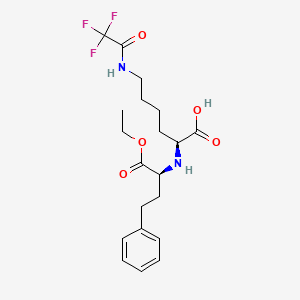
CAS · 116169-90-5
Product Overview
N2-(1S-Ethoxycarbonyl-3-phenylpropyl)-N6-trifluoroacetyl-L-lysine is a high-purity pharmaceutical-intermediates supplied for industrial and specialty chemical applications. Contact our team for specifications, packaging options and lead times.
Product Specifications
| Description: | White or almost white powder |
|---|---|
| Assay (On dried basis): | 98.5%~102.0% |
| Solubility: | Sparingly soluble in methanol and chloroform |
| Identification: | IR spectrum accordance with LA2 reference spectrum |
| Specific rotation: | +6 to +9° |
| Loss on drying: | 1% max |
| Related substances Any individual unspecified impurity: | 1% max |
| Total impurities: | 2% max |
| R,R-LA2: | 0.1% max |
Applications
1. HIV Protease Inhibitor Intermediate
This compound is best known as a key synthetic intermediate in the preparation of HIV-1 protease inhibitors, particularly in the development of:
Indinavir (Crixivan®) - a widely studied and FDA-approved antiretroviral drug used in HAART (Highly Active Antiretroviral Therapy).
The molecule mimics peptide substrate residues and contributes to the transition-state isostere in protease inhibitors.
2. Peptidomimetic Drug Design
The modified lysine backbone provides stability against enzymatic degradation, making it a valuable scaffold in the synthesis of peptidomimetics.
Commonly used in the design of enzyme inhibitors, especially those targeting aspartyl or serine proteases.
3. Medicinal Chemistry Research
Used as a tool compound or intermediate in:
Structure–Activity Relationship (SAR) studies
Development of bioisosteres that mimic natural amino acids
Designing transition-state analogs for enzyme inhibition
4. Custom Peptide and Modified Protein Synthesis
This modified lysine derivative can be incorporated into custom peptides for studying:
Enzyme–substrate interactions
Protease selectivity
Non-natural amino acid incorporation
Benefits
1. Transition-State Mimicry
The structure closely mimics the tetrahedral transition state of peptide bond hydrolysis, enabling strong binding affinity to protease active sites.
This contributes directly to the potency of HIV protease inhibitors.
2. Enhanced Protease Resistance
The N² and N⁶ modifications render the molecule resistant to peptidases and proteases, improving metabolic stability in vivo.
Important for oral bioavailability and longer drug half-life.
3. Synthetic Versatility
The molecule contains multiple reactive handles (e.g., ester, amide, trifluoroacetamide) that can be selectively modified or deprotected depending on the synthetic pathway.
Easily incorporated into multi-step synthesis protocols.
4. Stereospecificity
With a defined (1S) configuration, it contributes to stereoselective binding in biological systems-important for drug efficacy and safety.
Conclusion
N²-(1S-Ethoxycarbonyl-3-phenylpropyl)-N⁶-trifluoroacetyl-L-lysine (CAS 116169-90-5) is a specialized L-lysine derivative used primarily as an intermediate in the synthesis of HIV protease inhibitors such as indinavir. Its well-designed structure mimics enzyme substrates and transition states, making it a powerful component in drug discovery and peptidomimetic research. Its dual-protected amine groups provide synthetic flexibility and resistance to enzymatic degradation, supporting its use in the creation of stable and potent therapeutic agents.
Previous
4-Biphenylcarboxylic Acid丨CAS 92-92-2
Next