
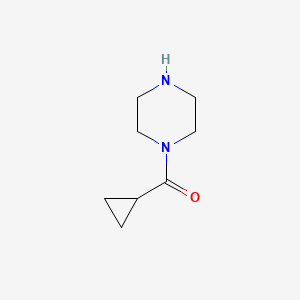
CAS · 59878-57-8
Product Overview
1-(Cyclopropylcarbonyl)piperazine is a high-purity pharmaceutical-intermediates supplied for industrial and specialty chemical applications. Contact our team for specifications, packaging options and lead times.
Product Specifications
| Appearance | Colorless to light yellow sticky liquid |
|---|---|
| Purity (GC) | 98% min. |
| Assay (Calculated on the dried basis) | 95% min. |
| Water | 0.5% max. |
| Piperazine (TLC) | 0.1% max. |
| Identification | HPLC conforms |
Applications
Pharmaceutical Intermediate
1-(Cyclopropylcarbonyl)piperazine is a crucial intermediate in the synthesis of various pharmaceutical compounds. Notably, it is used in the production of Olaparib, a drug approved for the treatment of certain cancers.
Organic Synthesis
This compound serves as a versatile building block in organic synthesis, enabling the construction of complex molecules with potential therapeutic applications.
Research and Development
Employed in research settings to explore new chemical entities and to develop novel therapeutic agents, particularly in the field of oncology.
Benefits
High Purity
Available in high purity forms (typically ≥98%), ensuring consistent performance in synthetic applications.
Chemical Stability
Exhibits stability under standard laboratory conditions, facilitating reliable handling and storage.
Functional Group Compatibility
The presence of both a piperazine ring and a cyclopropylcarbonyl group allows for diverse chemical transformations, enabling the synthesis of a wide range of derivatives.
Regulatory Compliance
Meets the quality standards required for pharmaceutical manufacturing, supporting its use in the production of clinical-grade compounds.
Conclusion
1-(Cyclopropylcarbonyl)piperazine (CAS 59878-57-8) is a valuable compound in pharmaceutical synthesis, offering versatility and stability for the development of complex therapeutic agents. Its high purity and functional group compatibility make it an essential intermediate in the production of drugs like Olaparib. As research continues to explore its potential, this compound remains a cornerstone in the development of novel treatments, particularly in oncology.
Previous
Next